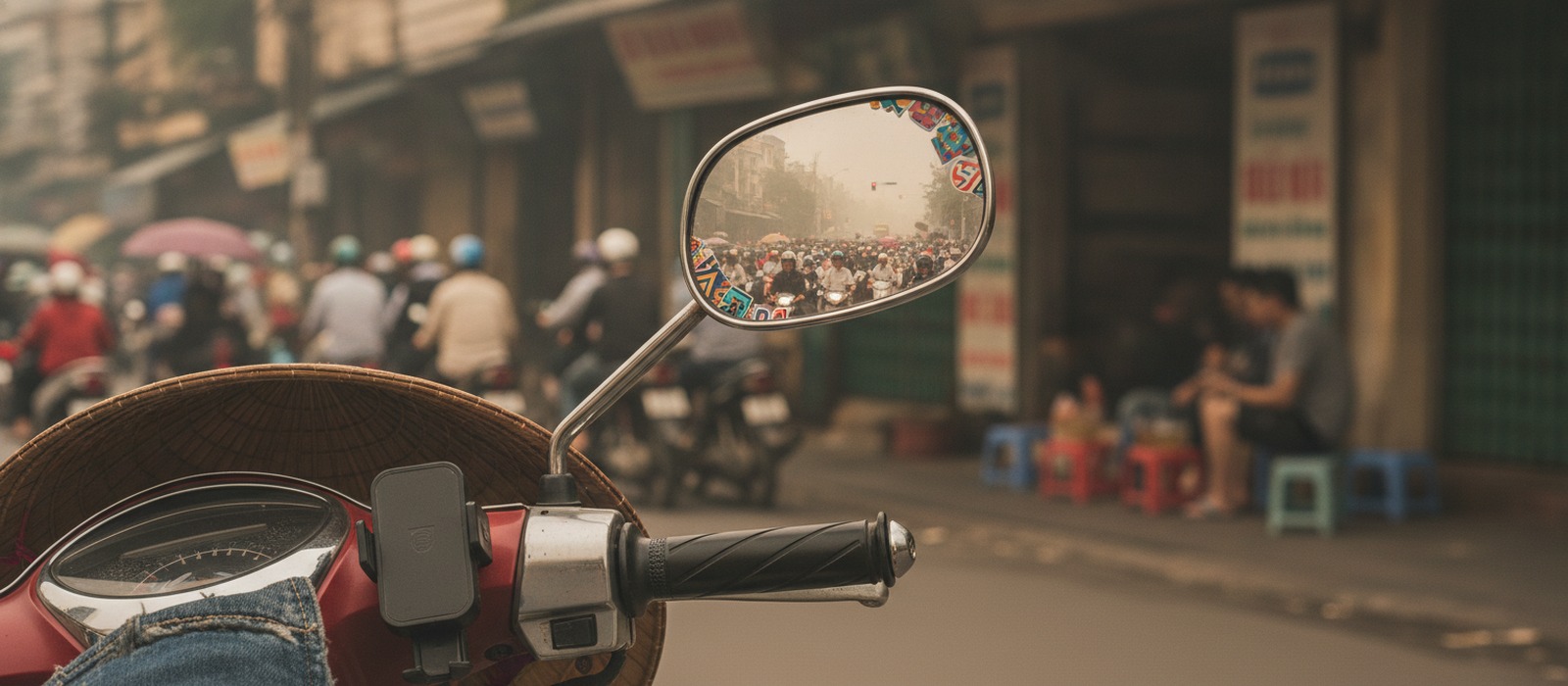
Vietnamese motorbike slang carries more information than it looks like it should. A single word such as "quái xế" tells a bystander in Hanoi whether the rider behind them is showing off or genuinely dangerous, and "làm luật" tells nobody but the two people involved that cash just changed hands with a traffic officer. These are not textbook words, and using the wrong one in front of the wrong person turns a joke into an accusation. This guide breaks down the terms Vietnamese speakers actually use around motorbikes: their literal meaning, their real meaning, and exactly who is allowed to say them out loud.
- 🛵 "Ôm" means hold on, xe ôm literally translates to "hug vehicle, " describing how a passenger rides.
- 🚨 "Quái xế" is an insult, not a title, Vietnamese media uses it for reckless street racers, never as a compliment.
- 💸 "Làm luật" is not legal advice, the phrase means paying a traffic officer on the spot, and outsiders should never say it aloud.
- 🔧 "Độ" turns a stock bike into a statement, a modified engine or exhaust carries its own vocabulary and its own reputation.
The vocabulary splits into three areas that rarely show up in the same lesson: who is on the bike, who is getting paid, and what the bike itself has become.
Why Vietnamese Motorbike Slang Starts With the Word "Ôm"
"Xe" means vehicle and "ôm" means to hug or hold. Put together, "xe ôm" literally means "hug vehicle," and its real meaning is a motorbike taxi: a driver who carries a passenger on the back seat for a fee, long before ride-hailing apps existed. The literal image is not decorative. A passenger on a xe ôm has nothing to hold onto except the driver, a strap, or their own knees.
That same root shows up in "ôm eo," literally "hug the waist," which describes a passenger wrapping their arms around the driver's waist instead of gripping the seat rail. Among couples in Vietnam, a first "ôm eo" on a motorbike carries a small romantic weight that a stranger holding a strap does not.
What does "xe ôm" actually mean today?
GrabBike did not erase the word. Vietnamese speakers still say "xe ôm" for the freelance driver waiting at a street corner, and reserve "Grab" or "xe ôm công nghệ" (literally "technology xe ôm") for the app-based version. On the German expat riding in Saigon in the "Annie meets Vietnamese Learners #2" interview, the guest describes local motorbike taxis in the city as reliable, in contrast with the smaller, less regulated drivers found outside Saigon.
Waiting itself has its own culture. A photo thread on r/VietNam shows xe ôm drivers pulling out a chessboard between customers, playing a few games at a street corner rather than chasing fares on their phones. It is a small detail, but it matches how the word "xe ôm" names a person and a routine, not just a transaction. International coverage of Southeast Asian urban mobility, including pieces from the World Economic Forum, has repeatedly pointed to Vietnam's motorbike density as among the highest in the region, which is part of why a single word for "the motorbike driver on the corner" earned its own permanent place in the language.
How Vietnamese Riders Describe a Reckless Ride
"Quái" means freak or monster, and "xế" is a colloquial shortening of "xe," used for a rider or a vehicle. Together, "quái xế" names a street racer: someone weaving through traffic at speed, often on a modified bike, often at night. Vietnamese newspapers use the word constantly for illegal racing groups, and traffic police use it in official statements. It is not a badge riders wear proudly among strangers.
Calling someone "quái xế" to their face is closer to an accusation than a joke. Among a tight friend group who all ride the same way, it can pass as banter. Said by a stranger, or by a foreigner who just learned the word, it reads as a judgment on someone's driving and, by extension, their character.
Two more words travel with "quái xế." "Nẹt pô" means to rev the exhaust pipe loudly on purpose, "pô" being a Vietnamese borrowing of the French "pot d'échappement." "Bốc đầu," literally "lift the head," describes pulling a wheelie. Both are performance moves, often filmed for TikTok, and both draw the same audience: teenage boys showing off for each other, and neighbors calling it noise pollution.
Is "nẹt pô" actually against the rules?
Vietnamese traffic regulation treats an illegally modified, excessively loud exhaust as a fine-able violation, separate from the act of revving it. That legal detail rarely comes up when the word is used casually. In everyday speech, "nẹt pô" describes the sound and the attitude behind it, not the paperwork. For the separate case of loud, celebratory riding after a win rather than a display of bravado, see đi bão, which runs on a completely different social register even though it can look identical from the sidewalk. The broader vocabulary of showing off on two wheels overlaps heavily with the slang covered in Viet Slang Decoded, since most of it comes from the same teenage and young-adult crowd.
The One Phrase No Foreigner Should Ever Say to a Traffic Cop
"Làm luật" literally means "to make the law." Its real meaning is the opposite of what it sounds like: paying a traffic officer cash on the spot instead of receiving an official ticket. Vietnamese speakers use it after the fact, describing what happened, almost never as a suggestion said out loud to the officer in the moment.
The register warning here is absolute. "Làm luật" belongs to private conversation between Vietnamese friends, never to the roadside exchange itself, and a foreigner who says it to an officer either gets no reaction or gets treated as making an accusation. A broader, non-motorbike-specific cousin is "bôi trơn," literally "to lubricate," used the same way for any informal payment that smooths over a bureaucratic problem. Riders also shorten "cảnh sát giao thông" (traffic police) to the acronym CSGT in speech and in text.
The interview "LEARN VIETNAMESE and TRAVEL AROUND VIETNAM BY MOTORBIKE!" on the Levion channel includes a concrete version of this reality. The guest, Konrad Schindler, describes being stopped by police during his motorbike trip from Hanoi to Saigon and asked for money. Because he kept cash split across several pockets rather than one wallet, he handed over only what the officer could see, a habit he says he picked up by reading it online before the trip.
Why do foreigners get stopped more often?
Neither video source claims a fixed reason, and none should be invented here. What both interviews agree on is practical: carry a passport valid for more than six months, keep registration papers on the bike, and expect that a foreign face on a rented motorbike draws more attention from checkpoints than a local one does. Konrad Schindler's own route rule, never more than six hours of riding per day, came from the same trip, spread over two weeks on the road out of a total three and a half weeks in the country.
What Vietnamese Bikers Call Their Machines
"Độ" means to tune or modify, and "xe độ" names a motorbike that has been customized: a bigger exhaust, a re-tuned engine, altered bodywork. The opposite is "xe zin," a stock, unmodified bike, "zin" being a casual borrowing commonly explained as coming from the English word "genuine." A seller advertising a "xe zin" is promising the buyer nothing has been touched under the seat.
Somewhere between the two sits "xe cà tàng," an old, beat-up motorbike that still runs. The phrase carries a distinctly Southern conversational flavor and is used both to complain about a bike and, just as often, to describe it with a kind of affection, the way someone might talk about a car that has survived past its expected lifespan.
None of this vocabulary appears in the parts glossaries built for mechanics. The terminology guide published by vietnammotorbikerental.com lists precise engine and repair terms in Vietnamese, such as "lọc gió" for air filter and "đẩy nổ" for a bump start, aimed at travelers explaining a mechanical problem to a repair shop. It is accurate and useful, and it says nothing about "độ," "zin," or "cà tàng," because those words describe identity and reputation, not parts.
What is the difference between "xe zin" and "xe độ"?
"Xe zin" is a claim about originality: nothing has been swapped or tuned since the factory. "Xe độ" is a claim about intent: the owner changed something on purpose, usually for sound, speed, or looks. The same Honda Alpha mentioned by the German rider working in Saigon in the "Annie meets Vietnamese Learners #2" interview could describe either state, depending on whether its owner left it alone or took it to a shop that specializes in "độ."
| Term | Literal meaning | Real meaning | Register risk |
|---|---|---|---|
| Xe ôm | Hug vehicle | Motorbike taxi | Safe everywhere |
| Ôm eo | Hug the waist | Holding the driver while riding pillion | Safe, carries romantic weight between couples |
| Quái xế | Freak rider | Reckless street racer | Insult if said to someone's face |
| Nẹt pô | Rev the exhaust pipe | Revving loudly to show off | Fine among peers, irritating or illegal elsewhere |
| Làm luật | Make the law | Bribing a traffic officer | Private talk only, never said to police |
| Xe độ / xe zin | Modified / genuine vehicle | Customized bike / unmodified bike | Safe, used openly when buying or selling |
SOURCE : transcripts cités, r/VietNam, vietnammotorbikerental.com · MAJ 09/2026
The Verdict on Vietnamese Motorbike Slang
Vietnamese motorbike slang divides cleanly along three lines: who is riding, who is getting paid, and what the machine has become. Get the register wrong on any of the three, and a word meant as observation lands as an accusation instead. "Xe ôm" and "xe zin" travel safely in almost any conversation. "Quái xế" and "làm luật" do not, and treating them as harmless small talk is the fastest way to say something a Vietnamese listener will not forget.
Learning these words from a transcript is a start, not the finish line. The slang dictionary at vietslang.com/slang lists every word covered here, and many more, with its region and its register attached, so the risk gets flagged before the word does.
FAQ
What does "xe ôm" mean in Vietnamese?
"Xe ôm" literally means "hug vehicle" and refers to a motorbike taxi driver who carries a passenger for a fee. The word predates ride-hailing apps and is still used for freelance drivers waiting at street corners, separate from "xe ôm công nghệ," the term for an app-booked ride such as GrabBike.
Is it safe to call someone "quái xế" in Vietnamese?
Not to their face. "Quái xế" describes a reckless street racer and is used by Vietnamese media and police as a negative label, not a compliment. Among a close friend group who all ride the same aggressive way, it can pass as banter, but a stranger or a learner using it risks sounding like they are accusing someone of dangerous driving.
What does "làm luật" mean and when do people use it?
"Làm luật" literally means "to make the law" and really means paying a traffic officer cash on the spot instead of getting an official ticket. Vietnamese speakers use the phrase afterward, describing what happened to friends, never as something said aloud to the officer during the stop itself.
What is the difference between "xe zin" and "xe độ"?
"Xe zin" describes a stock, unmodified motorbike, with "zin" borrowed loosely from the English word "genuine." "Xe độ" describes a bike that has been customized, usually with a modified exhaust or engine. Buyers and sellers use both terms openly since they describe the condition of the bike, not a risky social situation.
Does Vietnamese motorbike slang change between North and South Vietnam?
Some of it does. "Xe cà tàng," used for an old, beat-up motorbike, carries a distinctly Southern conversational flavor even though it is understood nationwide today. Words tied to street racing and bribery, such as "quái xế" and "làm luật," are used consistently across the country because the situations they describe are national, not regional.
Sources
- LEARN VIETNAMESE and TRAVEL AROUND VIETNAM BY MOTORBIKE! | Viet Talk with YVT | Anh Konrad Schindler — Levion - Learn Vietnamese Online
- Annie meets Vietnamese Learners #2: Driving motorbike in Saigon with Suza — Learn Vietnamese With Annie
- Terminology For Motorbikes - Vietnam Motorbike Hanoi Rental — vietnammotorbikerental.com
- What Vietnamese motorbike taxi drivers do while waiting for customers — r/VietNam