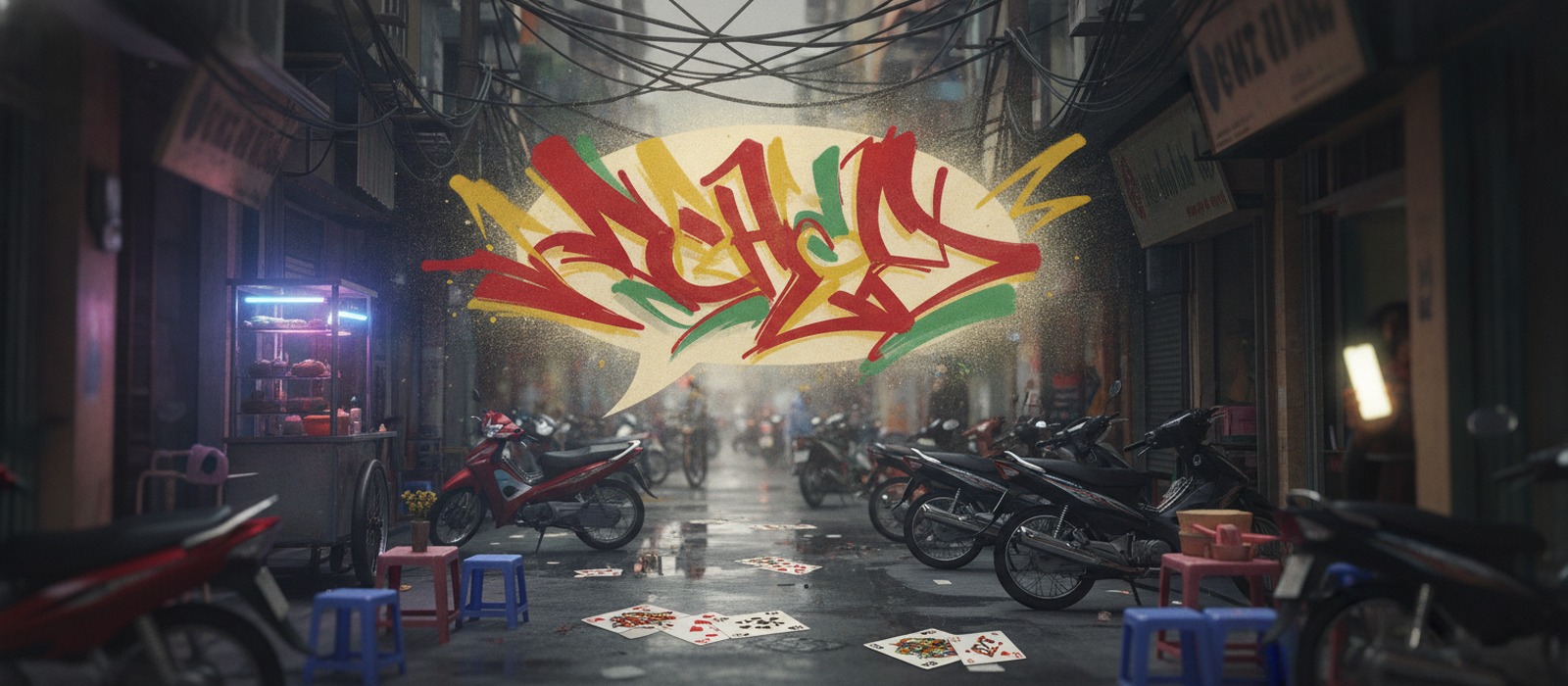
Viet slang is the layer of casual, often improvised vocabulary that Vietnamese speakers use in daily conversation, texting, and social media, and it rarely shows up in a phrasebook. Someone who has studied polite, textbook Vietnamese for months can still sit in a group chat and understand none of it, because the words are recycled from ordinary objects (fire, onions, a belt, a plow) and pointed at a completely different meaning. The gap between the literal translation and the real meaning is the entire point of this vocabulary.
- 📱 Meaning splits in two, almost every viet slang term has a literal meaning and an unrelated real meaning.
- ⚠️ Register matters more than grammar, several words are fine with friends and risky with in-laws or coworkers.
- 🌍 North and South disagree, the same word, like "nịt, " means something different depending on the region.
- 💡 Texting has its own layer, abbreviations like "k" or "vk" barely overlap with spoken slang at all.
A Reddit user learning through r/HocTiengviet put it plainly: textbooks "teach you full sentences that are technically correct," but real conversation "sounds completely different." This guide works through the viet slang that actually shows up in that gap, term by term, with the literal meaning, the real meaning, and the register warning that keeps a fun word from becoming an awkward one.
What Counts as Viet Slang, and Why Textbooks Miss It
Viet slang covers three overlapping layers: internet-born expressions that spread through TikTok and Facebook, older colloquial phrases passed between friends and coworkers, and a separate set of texting abbreviations built for speed rather than humor. That first layer moves fast because the platforms it lives on are massive: Statista tracks Vietnam as one of the world's most social-media-saturated countries, with tens of millions of active users across Facebook, TikTok, and Zalo. Textbooks skip all three layers because slang changes too fast to print and because a phrase that sounds harmless in one setting can sound rude in another.
That instability is exactly what confuses learners. A beginner on r/HocTiengviet asked which slang or daily phrases to learn first, noting that native speakers lean on "short phrases, fillers, and casual expressions that don't always show up in lessons." Another thread in the same community, asking users for their single favorite slang word, got "xịn" (genuine, high quality) as a top answer, a word that never appears in a beginner textbook chapter but comes up constantly in real speech.
Why does textbook Vietnamese sound so different from real conversation?
Textbook Vietnamese is written to be grammatically complete and regionally neutral, so it avoids slang, avoids dialect-specific words, and avoids phrases that go out of date within a year. Real conversation does the opposite: it favors whatever is short, current, and understood inside a specific social circle, which is why the same sentence can sound stiff in a classroom and normal on the street.
The Internet Slang Vietnamese Gen Z Actually Uses
Vietnamese Gen Z slang mostly starts online, gets tested in comment sections, and only later spreads into spoken conversation. Several terms borrow an everyday object and twist it into an emotional or social meaning that has nothing to do with the object itself.
Xin lửa literally means asking someone for fire, as in a lighter for a cigarette or a candle. As slang, it means asking for the tea: the gossip, the backstory, the full update on whatever drama just broke out. Someone drops a shocking piece of news in a group chat, and the replies fill with "xin lửa."
Quay xe literally describes turning a vehicle around, a U-turn. As slang, it means backing out of a decision at the last second, the way someone might change their mind about a relationship, a plan, or a purchase moments before committing. The literal image (a driver suddenly reversing direction) maps almost perfectly onto the real meaning.
Tốc độ bàn thờ, or "altar speed," describes driving so recklessly fast that the driver seems headed straight for a framed photo on the family altar, which in Vietnamese custom is where the deceased are honored. It is dark humor about reckless motorbike riders, not a compliment.
Xin vía literally means asking for someone's "vía," a concept close to luck or personal aura in Vietnamese folk belief. When a friend passes an exam or lands a job, people jokingly say "xin vía" to ask for some of that luck to rub off on them.
Gato, explained by the channel What The Pho and confirmed independently on Mentalfloss, is short for "ghen ăn tức ở," roughly "jealous over food, resentful over a seat," and is used when someone is visibly envious of another person's success. It sounds playful between friends but can land as an accusation if aimed at someone who genuinely is not jealous, so it is a tease, not a neutral observation.
Trẻ trâu, built from "trẻ" (young) and "trâu" (water buffalo), describes someone reckless, immature, and prone to picking fights, often a teenager showing off online. This one carries real weight: calling an adult "trẻ trâu" to their face reads as an insult about their maturity, not a joke about farm animals, so it belongs in casual talk about a third party, never as a direct label.
Where do these internet slang terms come from?
Most trace back to a single viral video, meme, or livestream moment that got repeated until it became shorthand. "Tốc độ bàn thờ" grew out of motorbike-accident jokes on social media, while "xin lửa" plays on the idea that fire "enlightens" people the way gossip does, according to the explanation given in the Vietnamese-language lesson channel Levion. Once a phrase like this catches on, it spreads through comment sections faster than any dictionary can track it.
Flirting, Relationships and Showing Off: Vietnamese Slang for Social Life
A separate cluster of viet slang exists specifically for dating, relationships, and status display, and it tends to be more visual than the internet slang above: each term paints a small scene.
Thả thính, literally "dropping fish bait," means flirting, often without any real romantic intent behind it. Mentalfloss notes that the person doing the "thả thính" is frequently just enjoying the attention rather than pursuing a relationship, which is the whole reason the fishing metaphor works: bait, not a hook.
Phát cẩu lương, "distributing dog food," describes a couple showing affection in public in a way that makes single people around them feel excluded, the same feeling as a dog watching its owner eat without sharing. Two independent creators, the channel What The Pho and the lesson channel HowToVietnamese, describe the exact same phrase with the same meaning, which is a strong sign it is standard slang rather than a one-off joke.
Gấu, literally "bear," is a casual word for boyfriend or girlfriend, confirmed in Mentalfloss's list of viral terms. It sits alongside "vk" and "ck," texting shorthand for wife and husband that young couples use jokingly long before marriage, described in HowToVietnamese's breakdown of Vietnamese text abbreviations.
Quỹ đen, or "black fund," is money a husband secretly sets aside and hides from his wife, often behind a picture frame or under the TV, according to What The Pho's explanation of Vietnamese household finance customs. This term needs a real register warning: joking about "quỹ đen" with a Vietnamese friend at a bar is harmless, but bringing it up directly to someone's wife, implying her husband has one, can start a genuine argument rather than a laugh.
Chém gió, "chopping wind," means exaggerating or embellishing a story, the verbal equivalent of talking with your hands so much you could cut the air. It is used constantly and casually, including toward coworkers, since it describes storytelling flair rather than lying with malicious intent.
Is it safe to joke about quỹ đen with a Vietnamese friend?
Joking about "quỹ đen" is generally safe between friends discussing the concept in the abstract, since it references a well-known cultural pattern rather than a specific accusation. It becomes risky the moment it targets a real couple by name, especially in front of the wife, because it shifts from a cultural joke to an implied claim about that specific marriage.
The Words That Warn You Something Went Wrong
Several pieces of viet slang exist purely to react to bad luck, failure, or loss, and this is where regional differences show up most clearly.
Còn cái nịt, "only the nịt is left," means losing everything and being left with nothing of value. The phrase depends on region for its literal meaning: in the South, "nịt" means a belt, while in the North it refers to the elastic band used to tie hair or stacks of banknotes. Mentalfloss traces the phrase to a TikTok video about a man returning lost cash, keeping only the elastic band that once held the bills together, and leaving the owner with "cái nịt" and nothing else.
Xu cà na is an exclamation for something unlucky or disappointing. "Cà na" is a sour fruit, and "xu" carries no independent meaning on its own, but it sounds close to "xui," the Southern-dialect word for unlucky, which is why the phrase works as wordplay rather than a literal description of fruit.
Ăn hành, literally "eating onion," means getting badly beaten, humiliated, or destroyed, most often in gaming or a lopsided argument. A Reddit post in the r/LTL_Vietnamese community leads with exactly this contrast: "literally, 'ăn hành' means 'to eat onion,' but here's what this Vietnamese slang really means," underlining how sharp the gap between literal and real meaning gets in this corner of the language.
Bánh bèo, "water fern cake," a soft, delicate dish, describes a girl seen as overly delicate, stereotypically feminine, and dependent on others. It works as an affectionate tease among close friends but turns into a genuine insult when used to dismiss a woman's competence or personality, so it should never be used toward a stranger or a coworker.
Kỳ đà, meaning "lizard," describes a third wheel who shows up uninvited and ruins a moment, according to the illustrated slang guide on Abroader, which documents it as a Southern-Vietnam term tied to the country's football culture.
Why does "còn cái nịt" mean different things in the north and the south?
The word "nịt" itself splits along regional lines: Southern Vietnamese uses it for a belt, while Northern Vietnamese uses it for a small elastic band. The slang phrase "còn cái nịt" still means the same thing everywhere (losing everything down to one worthless leftover item), but the mental image behind it changes depending on where the listener grew up.
Vietnamese Texting Abbreviations You'll See in Every Group Chat
Texting slang runs on a different logic than spoken slang: it strips words down to a single letter or syllable purely to save time, with far less wordplay involved. HowToVietnamese's breakdown of Vietnamese texting shorthand lists the building blocks nearly every group chat relies on.
"K" or "ko" stands for "không" (no or not). "B" or "bn" stands for "bạn" (you or friend) or "bao nhiêu" (how much). "Vk" and "ck" stand for "vợ" (wife) and "chồng" (husband), used jokingly by dating couples long before marriage. "R" or "rùi" stands for "rồi" (already). None of these carry the emotional or cultural baggage of the spoken slang above; they exist purely for speed.
A few spoken slang terms cross over into texting culture too. "Cày," literally "to plow" a field, means grinding hard at work, study, or a video game marathon, per Mentalfloss. "Đỉnh," meaning "peak," describes something outstanding, and "cột sống," literally "spine," is a joking reference to the back pain caused by too much screen time. All three show up constantly in Vietnamese Gen Z captions and comments.
| Term | Literal meaning | Real meaning | Register / risk |
|---|---|---|---|
| xin lửa | asking for a lighter | asking for gossip or the full story | Friends, casual chats only |
| quay xe | turning the vehicle around | suddenly changing a decision | Any context, mildly playful |
| thả thính | dropping fish bait | flirting, often without real intent | Friends, dating conversations |
| phát cẩu lương | distributing dog food | public affection that excludes singles | Friends, teasing tone |
| còn cái nịt | only the belt or band is left | losing everything | Friends, not formal settings |
| ăn hành | eating onion | getting badly beaten or humiliated | Gaming and friends, can sting if serious |
SOURCE: video transcripts and Reddit threads cited · Updated 09/2026
How do Vietnamese texting abbreviations differ from spoken slang?
Texting abbreviations are almost entirely functional: they shorten a real word to save keystrokes and rarely change its meaning. Spoken slang, by contrast, usually keeps the full word but redirects its meaning entirely, which is why "vk" simply means "wife" while "thả thính" has nothing to do with fishing at all.
Vietnamese is spoken by roughly 86 million people inside the country, according to Mentalfloss, and by close to 100 million once the global diaspora is counted, per Ethnologue. That scale is part of why the slang layer moves so fast: with that many speakers producing content daily, a phrase coined in a single livestream can become nationwide shorthand within weeks. Anyone building spoken fluency alongside slang should also look at how Vietnamese sentence structure actually works, since slang words still have to slot into standard grammar to make sense in a full sentence, and the pronoun system in particular trips up learners fast, which is covered in what "mình" actually means in Vietnamese.
None of the words above are safe to use everywhere. "Gato," "trẻ trâu," "bánh bèo," and "ăn hành" all work fine among friends and fall flat, or worse, in front of family, coworkers, or strangers. The safest approach for a learner is to treat every new slang word the way native speakers already do: notice who says it, notice who they say it to, and copy the audience before copying the word. Viet slang rewards that kind of listening far more than it rewards memorizing a list, which is also true of other spoken-only vocabulary Vietnamese speakers use without ever writing it down, the kind no textbook bothers to cover.
Frequently Asked Questions
What does "viet slang" mean exactly?
Viet slang refers to the informal vocabulary Vietnamese speakers use in daily conversation, texting, and social media that differs from the standard, textbook version of the language. It includes internet-born expressions, older colloquial phrases, and separate texting abbreviations, all of which change faster than formal dictionaries can track.
Is Vietnamese Gen Z slang the same across the whole country?
No. Some terms, like "còn cái nịt," rely on a word ("nịt") whose literal meaning changes between North and South Vietnam, even though the slang meaning stays constant. Other slang, like "xu cà na," depends on a Southern-dialect pronunciation to make sense as wordplay.
Can foreigners use Vietnamese slang without offending anyone?
Most viet slang is safe in casual settings with friends, but a handful of terms, including "trẻ trâu," "bánh bèo," and "quỹ đen," can sound insulting or invasive outside of that context. The safest rule is to listen for who a Vietnamese speaker uses a word around before using it toward someone new.
Where does Vietnamese internet slang come from?
Most viral Vietnamese slang starts with a specific TikTok video, livestream moment, or meme that gets repeated until it becomes shorthand, rather than evolving gradually like older colloquial phrases. That origin story is part of why the meaning can seem completely disconnected from the literal words, as with "còn cái nịt" tracing back to a single video about returned lost cash.
How is Vietnamese texting slang different from spoken slang?
Texting abbreviations like "k" (không, no) or "vk" (vợ, wife) mostly shorten existing words for speed and keep their original meaning intact. Spoken slang like "thả thính" or "ăn hành" keeps the full word but assigns it an entirely different meaning, which is what makes it harder for learners to guess from context.
Sources
- Vietnamese Slang - How Do Vietnamese People Actually Talk in Everyday Life? — Levion - Learn Vietnamese Online
- 10 Vietnamese Slangs that You Should Know — What The Pho
- 5 Must-know Modern Slang in Vietnamese | Vietnamese phrases — HowToVietnamese
- What is "KO"? Learn Common Vietnamese Texting Slang and Abbreviations — HowToVietnamese
- 10 Viral Vietnamese Slang Terms — mentalfloss.com
- 6 Vietnamese Slang Words in the South Through Illustrations — abroader.org
- Any Vietnamese slang or daily phrases should beginners learn first? — r/HocTiengviet
- What's your favorite Vietnamese slang, ONE word? — r/HocTiengviet
- Literally, 'Ăn hành' means 'to eat onion' but here's what this Vietnamese slang really means... — r/LTL_Vietnamese