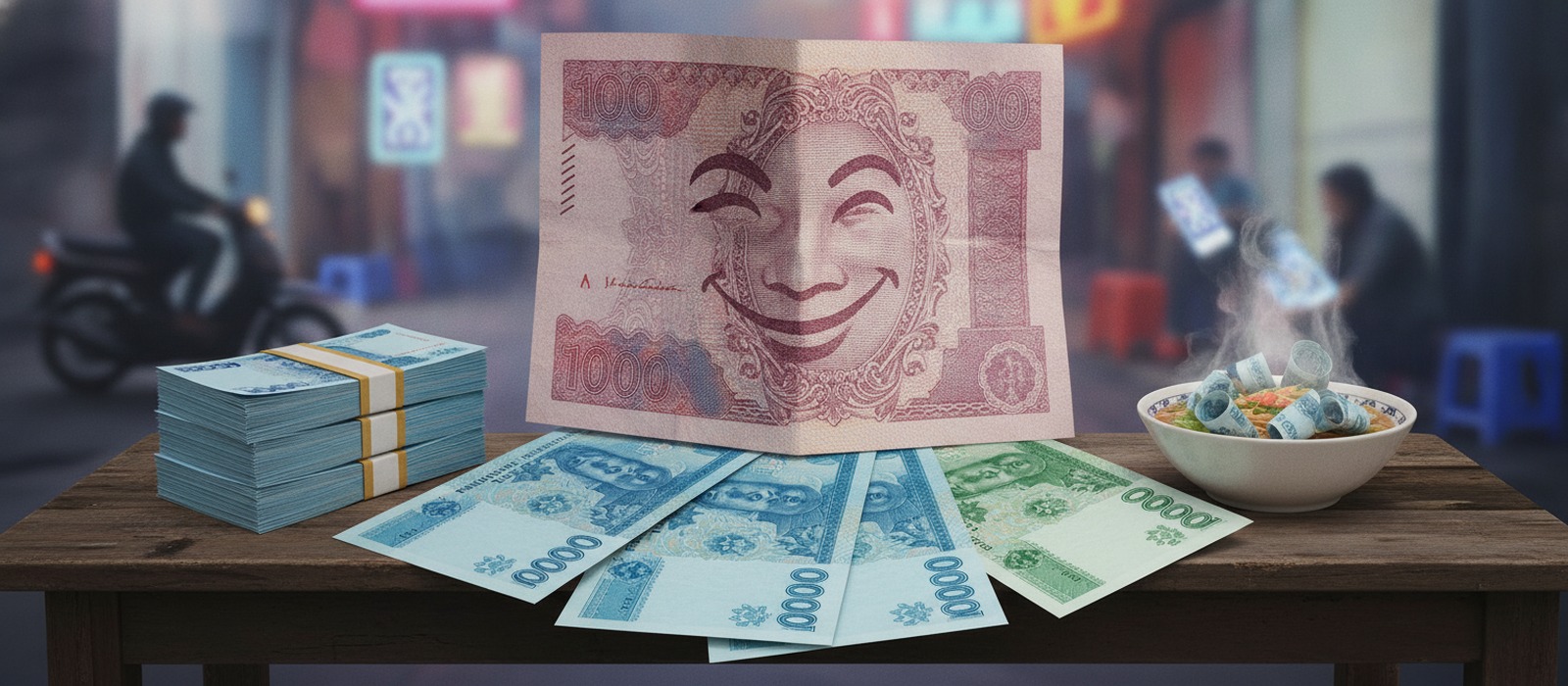
Vietnamese dong currency slang is the set of short nicknames speakers use instead of saying the full amount: lít and xị for 100,000 dong, củ and chai for 1,000,000 dong, and k for a thousand. They exist because dong amounts carry many zeros, and everyday talk about rent, phone repairs and lunch needs a faster way to say them.
Textbooks teach một trăm nghìn and một triệu. A friend quoting a price in a chat or at a café will usually not.
- 💰 Four core words, lít, xị, củ and chai replace "hundred thousand" and "million" in daily talk.
- 🌍 North versus South, lít and củ lean Northern, while xị and chai lean Southern.
- ⚠️ Register matters, money nicknames are casual, and accusing words like chặt chém can start arguments.
- 💡 Zero checks, a 20,000 note and a 500,000 note look alike, so say amounts aloud.
The sections below go from the words themselves, to the region split, to the vocabulary Vietnamese speakers use to complain about prices, and finally to the habits that keep you from paying the wrong note.
What do lít, xị, củ and chai mean in Vietnamese money slang?
Four nicknames cover most spoken prices: lít and xị mean 100,000 dong, and củ and chai mean 1,000,000 dong. All four are ordinary nouns borrowed for money, and each has a literal meaning that has nothing to do with currency.
According to the Tiếng Việt Ơi lesson "Money Slang", lít is the liter, as in a liter of milk or petrol. Xị is the Southern word for a small bottle of about a quarter liter, such as a bottle of fish sauce. Củ is a root vegetable, such as garlic, carrot or potato. Chai is a bottle.
The same lesson admits it does not know why these words stand in for money. They are not shorter than trăm nghìn or triệu, and they are not easier to pronounce. That candor is worth keeping: no reliable origin story is documented in the sources used here, so treat any tidy explanation you read elsewhere with suspicion.
How do you use them in a real sentence?
You attach a number in front, exactly as you would with the literal noun. The Tiếng Việt Ơi lesson gives two examples: Tiền nhà mình 8 củ một tháng ("my rent is 8 củ a month", meaning 8 million dong) and a phone that fell in water costing 4 chai to fix (4 million dong).
At the exchange rate recorded by Wikipedia for 28 February 2026, 26,045 dong to one US dollar, 8 củ works out to roughly 307 dollars. That calculation is ours, not the lesson's, but it shows why renters in Vietnam mention rent in củ or chai and not in full numbers.
Quantity words stay the same as for any noun. Two lít is 200,000 dong, three xị is 300,000 dong.
Which words do Northerners and Southerners use?
The split is geographic. In the North, around Hanoi, speakers tend to say lít for 100,000 and củ for a million. In the South, around Saigon, speakers tend to say xị and chai.
The Tiếng Việt Ơi lesson, recorded in Hanoi, presents these as the Northern and Southern pairs. It also says all four are widely understood across the country, so a Northerner who hears chai in a Saigon café will not be lost. The pairing is a tendency, not a border.
If you want the wider context for why a word changes at the Hải Vân Pass, the Southern Vietnamese dialect guide and the Northern Vietnamese dialect guide cover tones and vocabulary.
What about "k" on menus and price tags?
The letter k is the shortest of all and the only one you will see written. According to Remitly's guide to the dong, k stands for thousand, so 50k means 50,000 dong and 100k means 100,000 dong. It is informal shorthand, not an official symbol.
Vietnamese-language formatting also uses a period as the thousand separator. Remitly points out that 50.000 ₫ equals 50,000 dong, not 50 dong.
One reading rule saves you most mistakes: three zeros after the k, never before. Menus use 50k, not 50.000k.
| Slang | Region | Value in dong | Literal meaning | Written or spoken |
|---|---|---|---|---|
| k | Everywhere | 1,000 | Abbreviation of thousand | Written, also spoken |
| lít | North | 100,000 | Liter | Spoken |
| xị | South | 100,000 | Small bottle, about a quarter liter | Spoken |
| củ | North | 1,000,000 | Root vegetable | Spoken |
| chai | South | 1,000,000 | Bottle | Spoken |
SOURCE : Tiếng Việt Ơi, Remitly · MAJ 11/2026
Where does the word đồng itself come from?
Đồng is the Sino-Vietnamese word for copper (銅), and it is also the name of the Vietnamese currency, in use since 3 May 1978 and issued by the State Bank of Vietnam. The currency name and the word for money in general overlap, which is why Western Union notes that "dong" means currency in general and that travelers may hear đồng Việt Nam for the local currency.
Money slang has a long history of its own. According to Wikipedia's article on Vietnamese cash coins, in the Điếm slang of lower-class Saigon in the late 19th century, the term tể referred to cash coins and was an abbreviation of tiền (錢). Nothing in that source suggests the term survives today, so it is a historical footnote, not vocabulary for your next conversation.
Why does the dong have so many zeros?
Because of inflation, the long-run erosion of a currency's purchasing power that bodies such as the OECD track across economies. Wikipedia records that the old subunits, the hào (one tenth of a dong) and the xu (one hundredth), have been unused for decades. The 500,000-dong note has been the highest denomination in circulation since 2003, and polymer notes of 10,000 dong and above also date from 2003 onward.
The Wikipedia page also lists the dong as the third-lowest valued currency unit on 28 February 2026, behind the Iranian rial and the Lebanese pound. High numbers push everyday speech to compress them, and lít, xị, củ and chai are that compression.
How do Vietnamese speakers talk about cheap, pricey and broke?
Beyond counting, Vietnamese has a whole set of expressions for how money feels. The Easy Vietnamese lesson "Talking about money" covers several. The audio transcript of that lesson is partly garbled, so the entries below keep to the words it clearly names and flag where the lesson is the only support.
- Rẻ bèo means dirt cheap. Rẻ is cheap and bèo is a floating water plant. Why that plant was chosen is not documented in the lesson.
- Giá chát describes a price that is painfully high. Chát literally describes a harsh, astringent taste.
- Chặt chém is the act of overcharging, literally "chop and slash". The lesson's example is that Vũng Tàu is famous for ripping off tourists.
- Nghèo rớt mồng tơi means flat broke. Mồng tơi is Malabar spinach, and the phrase literally says someone is so poor they have fallen to the level of spinach.
For the bargaining side of the same vocabulary, the nói thách guide explains how inflated tourist prices are named and answered.
Which of these words can get you in trouble?
Two of them, in specific settings. Chặt chém is an accusation. Said about a restaurant to a friend, it is casual griping. Said to a seller's face, it can turn a negotiation into an argument.
Nghèo rớt mồng tơi is harmless about yourself ("I'm broke this month") and rude about someone else's family. Never use it about a host, partner or relative's household in front of them. Rẻ bèo is safe about a product but can sound insulting about a service someone provides.
Choosing between anh, chị, cô or chú when you do speak to a seller is the other half of staying polite, and the Vietnamese address words guide walks through it.
How do you avoid paying the wrong note?
Say the amount aloud and read the zeros, not the color. A Reddit thread in r/VietnamTravelPlanning warns that the 20,000-dong and 500,000-dong notes are both blue-toned and one is worth 25 times the other, so the mix-up is easy when tired or in a hurry.
The thread's author suggests saying the amount as you hand it over, and notes that this clarifies the payment but "won't prevent every mistake or dispute". The author also says ATMs often dispense 500,000-dong notes and recommends breaking them at a supermarket, because a street food stall may struggle to give change. This is one traveler's account, not an official rule, but it matches the structure of the currency.
The same number discipline helps with slang. If a seller quotes "hai xị", that is 200,000 dong, not two of anything else. Repeat it back in digits when stakes are real.
Remitly also notes that Vietnam is cash-forward rather than cash-only: according to the Vietnam National Authority of Tourism, hotels, restaurants and tour operators generally accept cards, while small purchases and street vendors are mostly cash. Slang prices come up most in those cash settings.
Once lít, xị, củ and chai feel natural, the next layer is the rest of daily speech that never appears in textbooks. The Vietnamese slang dictionary lists each word with its register and region, so you can check who may hear it before you say it.
So which money word should you actually use?
Use k when writing, and the pair that matches where you live when speaking. In Hanoi, lít and củ will sound natural. In Saigon, xị and chai will. Elsewhere, any of them will be understood, and the full trăm nghìn and triệu never sounds wrong, only slower.
The nicknames are casual by design. Use them with friends, colleagues, shopkeepers you know and rent talk with landlords you are on easy terms with. For contracts, invoices and anything official, say and write the full figure.
FAQ
What is "củ" in Vietnamese money slang?
Củ means one million dong. Literally it is a root vegetable such as a potato, carrot or garlic bulb. According to the Tiếng Việt Ơi lesson, it is the Northern choice, and "8 củ a month" is how a rent of 8 million dong gets said.
What is "xị" and "lít" in Vietnamese money slang?
Both mean 100,000 dong. Lít is the Northern word and literally means liter. Xị is the Southern word and literally means a small bottle of about a quarter liter. They are interchangeable in meaning and differ in region and habit.
Is "k" really used in Vietnam for thousand?
Yes. Remitly's guide to the dong says k is common shorthand on menus, signs and casual listings, where 50k means 50,000 dong. It is informal, so use full figures in anything official.
Is the word "dong" itself slang?
No. Đồng is the official currency name, from the Sino-Vietnamese word for copper, and the code is VND. It also works as a general word for currency, so locals may add "Việt Nam" to be clear.
Are money slang words offensive?
The counting words are not. The words about prices and poverty are more delicate: chặt chém accuses someone of overcharging, and nghèo rớt mồng tơi is rude about another person's household. Keep both for yourself or for friends, never for strangers or hosts.
Sources
- Money Slang | Learn Vietnamese Slang and Idioms with TVO — Tieng Viet Oi - Vietnamese Lessons
- Learn Vietnamese Slang: Talking about money — Easy Vietnamese
- Vietnamese đồng — en.wikipedia.org
- Vietnamese cash — en.wikipedia.org
- Vietnamese Currency Guide: The Dong (VND) Explained — remitly.com
- Vietnam currency guide: The Vietnamese dong (VND) — westernunion.com
- Vietnamese banknotes: check the zeros on 20,000 and 500,000 dong — r/VietnamTravelPlanning
- State Bank of Vietnam — sbv.gov.vn