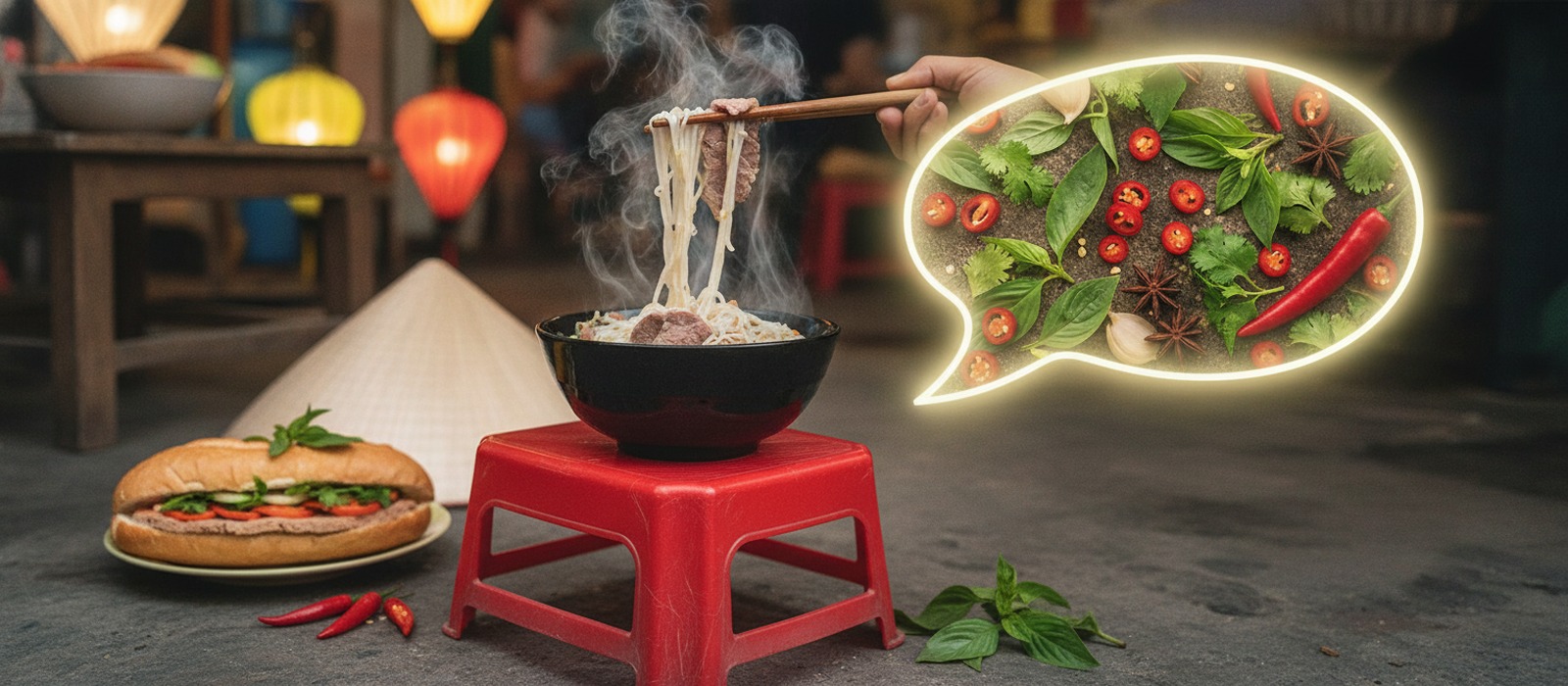
To order food in Vietnamese, build one sentence: cho (give) + a pronoun + a number + a classifier + the dish, as in Cho em một tô phở, "one bowl of phở, please." Everything else, from calling the waiter to asking for the bill, is a short phrase whose wording shifts with the age of the person you are speaking to. This guide combines four video lessons and five top-ranking guides, and marks the places where they disagree or where a wrong word costs you something. It starts with the formula, then covers calling the waiter, reading the menu, special requests and paying.
- 🎯 Core formula, cho, pronoun, number, classifier, dish: five words cover almost every order.
- ⚠️ Register risk, em, anh, chị, cô, chú must match the server's apparent age.
- 🌍 North versus South, peanuts are lạc in Hanoi and đậu phộng in Saigon.
- ⏱️ Pay at counter, say tính tiền, skip tipping, and expect no check folder.
The Order Formula: Cho + Pronoun + Number + Classifier + Dish
A Vietnamese food order follows the pattern cho + pronoun + number + classifier + dish. Cho literally means "to give", so Cho em một tô phở is literally "give me one bowl of phở" and, in practice, a polite "one phở, please." According to learnvietnameseeasy.com, "give me this one" sounds rude in English, but cho is exactly how Vietnamese speakers order politely and naturally.
Why does "give me" sound polite in Vietnamese?
Politeness does not sit in the verb. It sits in the pronoun you attach to it. In the examples from learnvietnameseeasy.com, the customer calls the server by a kinship word and refers to themselves with the matching one: Chị ơi, cho em một tô bún bò Huế ("Hey older sister, give me one bowl of Huế beef noodle soup") or Cô ơi, cho con một dĩa cơm gà ("Hey aunt, give me one plate of chicken rice").
Kaiwa's guide teaches the neutral alternative, Cho tôi... (tôi is the plain "I"). It works anywhere and nobody will be offended. The matched pair (chị ơi, cho em) is what sounds warmer, because it treats the server as family rather than as a stranger. For a longer explanation of how these words are chosen, see Vietnamese address words: who gets anh, chị, cô or chú.
If you do not know the dish, What The Pho and learnvietnameseeasy.com give the same escape route: point and say Cho em hai cái này ("give me two of this", where cái này literally means "this thing").
Which classifier goes with which dish?
A classifier is the small word between the number and the food, roughly "bowl of", "plate of" or "glass of". The most useful ones, drawn from learnvietnameseeasy.com and Flexi Classes:
- tô: a large bowl, used for noodle soups (một tô phở).
- dĩa: a plate, used for rice dishes (một dĩa cơm tấm, "one plate of broken rice"). Northern speakers write đĩa.
- chén: a small bowl, used for sauces (một chén nước mắm). In the north, bát covers bowls in general, which is why Flexi Classes' dialogue says một bát phở bò.
- ổ: a loaf, used for bánh mì (hai ổ bánh mì).
- ly: a glass (ba ly trà đá). chai: a bottle (ba chai nước). phần: a portion.
The classifier can often be dropped when the dish is obvious, but the pattern is worth keeping because it is what servers expect to hear. The numbers you need: một (1), hai (2), ba (3), bốn (4), năm (5), sáu (6), bảy (7), tám (8), chín (9), mười (10).
Southern speakers say đậu phộng and heo where Northern speakers say lạc and lợn, so the same order can sound different in Saigon. The gap between the two accents is covered in the Southern Vietnamese dialect guide.
Know the Eatery Before You Speak
Where you sit decides how you order. At a street stall you often speak directly to the cook, at a casual rice counter you point at trays, and in a sit-down restaurant you use a printed menu. According to vietnamtourism.com, these three types of eatery differ in ordering flow, payment and how likely the staff are to speak English.
| Eatery type | How you order | How you pay | English likelihood |
|---|---|---|---|
| Street stall (quán vỉa hè) | Call the server or speak to the cook; menu often handwritten or absent | Cash, right after eating | Rare |
| Rice counter (cơm bình dân) | Walk to the display and point at dishes | Before or after eating, depending on the place | Low |
| Restaurant (nhà hàng) | Printed menu, sometimes with pictures | Table or counter; cards accepted more often | More common |
| Café (quán cà phê) | Order at the counter or table; staff ask dine-in or take-away | At the counter or table | Varies |
SOURCE : vietnamtourism.com, Nutty Vietnamese · MAJ 11/2026
The literal meanings help the words stick: quán vỉa hè is "pavement eatery", cơm bình dân is "common people's rice" and nhà hàng is "house of goods", the standard word for restaurant.
How do you get a waiter's attention?
Raise one hand and say the server's pronoun followed by ơi. What The Pho's video shows exactly this, with Em ơi! for a younger server. Literally em is "younger sibling" and ơi is a calling particle, so the phrase works like "excuse me" with a friendly edge. Waiting silently does not work: vietnamtourism.com states that servers do not hover and leave you alone until you call them.
The same video explains why. Asking customers mid-meal whether everything is fine is considered rude in Vietnam, so staff stay away by design. That also explains the brisk order-taking: What The Pho notes that employees multitask, and standing at the table while you decide is a way of finishing one job before the next, not impatience.
Menu requests are the other thing the guides cover. Kaiwa gives Thực đơn, làm ơn ("menu, please"), and Nutty Vietnamese gives a longer sentence for asking to order. Neither is required: a raised hand and ơi is enough, and the menu usually arrives when staff are ready.
Who counts as em, anh, chị, cô or chú?
The pronoun must match the server's apparent age relative to yours. Kaiwa's rule of thumb: em for a younger server, chị for an older woman, anh for an older man. Migaku adds cô for an older woman and chú for an older man, the aunt and uncle level. Kaiwa advises em ơi "when in doubt".
That advice has a limit. Calling a clearly older woman em ("younger sibling") can sound dismissive. If the server is plainly your parent's age, use cô or chú. Avoid a bare Ê! ("hey!") across a restaurant: it is a blunt call that suits close friends, and toward a stranger it can read as rude.
Reading the Menu: Base, Protein, Method
Most Vietnamese dish names stack three ideas: a base (rice, noodles or porridge), a protein or topping, and sometimes a cooking method. Nutty Vietnamese teaches that once you know these building blocks you can decode almost any menu, and vietnamtourism.com describes the same pattern as main ingredient plus cooking method plus, at times, a regional name.
How are Vietnamese dish names built?
The bases first. cơm is cooked rice (and, by extension, a rice meal), which is why it comes first: rice is the staple of the Vietnamese table, a crop the FAO follows as a core food staple worldwide. phở is the rice-noodle soup. bún is round rice vermicelli. mì is egg noodles, miến is glass noodles, cháo is rice porridge and canh is a clear soup eaten alongside rice.
The proteins follow: bò (beef), gà (chicken), heo (pork, lợn in the north), tôm (shrimp), mực (squid), hải sản (seafood), rau (vegetables) and nấm (mushrooms). The methods: chiên (fried), xào (stir-fried), nướng (grilled).
Stack them and the menu opens up. Cơm gà is chicken rice, mì xào bò is stir-fried egg noodles with beef, bún bò is beef noodle soup. Nutty Vietnamese adds that most dishes come in three sizes: large, medium and small.
What if the menu has no photos?
Many stalls serve a single dish and list it on a sign. What The Pho advises trying your best to pronounce the name and ordering with the standard formula, for example Cho em hai tô phở bò. According to vietnamtourism.com, English is rarely spoken at street stalls, so a clear dish name and a number matter more than a full sentence.
Restaurants in Vietnam also tend to specialise. What The Pho notes that a phở restaurant sells phở and a rice restaurant sells rice, unlike Vietnamese restaurants in the United States where phở, bún bò Huế and cơm tấm share one menu. For ways to ask a local what is worth ordering, see Vietnamese food recommendation slang.
Special Requests, Allergies and Saying You Are Full
Special requests in Vietnamese are short, usually không + the ingredient. Không literally means "none" or "empty" and in practice it is simply "no" or "without". The request goes after the order, before the server heads back to the kitchen.
How do you ask for no fish sauce, no peanuts or no MSG?
The standard set, combining What The Pho and Nutty Vietnamese:
- Không cay: not spicy.
- Không nước mắm: no fish sauce. Nước mắm is literally "fish water", the fermented fish sauce.
- Không đậu phộng (Southern) or không lạc (Northern): no peanuts.
- Không bột ngọt or không mì chính: no MSG. What The Pho gives mì chính, which is the term most associated with the north; bột ngọt is the standard form, and the one heard in the south.
- Tôi ăn chay: I eat vegetarian. Chay is vegetarian.
What The Pho warns that vegetarians may still be served fish sauce by accident, which is why không nước mắm belongs in the same sentence as ăn chay. For a real allergy, không đậu phộng is not enough: use tôi bị dị ứng đậu phộng ("I am allergic to peanuts", where dị ứng is "allergy"). What The Pho points out that peanuts are widely used in Vietnamese cooking.
How do you order drinks and ice?
After the food, the server asks what you would like to drink. The pattern is identical: cho + pronoun + number + ly or chai + drink. Examples from Flexi Classes: ba ly trà đá (three glasses of iced tea) and một ly cà phê sữa đá (one iced coffee with condensed milk).
Nutty Vietnamese observes that almost every drink arrives over ice by default, especially in the south where the heat lasts all year, and that trà đá (iced tea) is usually free at restaurants. To avoid ice, say không đá ("no ice"), and add ít đường for less sugar. What The Pho's example order, "a medium beef phở and an orange juice without ice and sugar", maps to không đá, không đường.
How do you say you are full without offending the host?
Say no rồi. No literally means "full" (sated), rồi marks something as already done, so it is "already full." What The Pho adds why it matters: Vietnamese hosts show affection through food, and guests are often pushed to keep eating.
Added politely, it lands softly: Dạ, em no rồi ạ. Dạ is a polite "yes, I hear you" and ạ is a respect particle closing the sentence. With a host of your parents' generation, con ("child") replaces em, as in the cho con example earlier. Between people of the same age, con would sound odd.
Paying, Takeaway and the Verdict
At the end of the meal, ask for the bill with tính tiền: tính is "to calculate" and tiền is "money." It means "bill, please." What The Pho's version adds the waiter's pronoun and the particle: Em ơi, tính tiền! Kaiwa's list adds làm ơn ("please"), which is textbook-correct but not required, since the pronoun and ơi already carry the politeness. This is the gap described in spoken Vietnamese versus the textbook.
How do you ask for the bill and the price?
Two phrases cover it. Bao nhiêu tiền? ("how much money?") asks for the total, and Kaiwa and Flexi Classes both list it for street food. Tính tiền asks for the bill. What The Pho and vietnamtourism.com agree that payment often happens at the counter or at the door rather than at the table, so do not wait for a bill to arrive. For money slang you will also hear in the street, see Vietnamese dong currency slang.
Takeaway uses two fixed phrases. Flexi Classes lists ăn ở đây ("eat here") and mang về ("take back", takeaway). Kaiwa lists mang đi for the same idea. Nutty Vietnamese adds that delivery apps such as GrabFood and ShopeeFood deliver in 15 to 40 minutes and use the same dish names you have just learned.
Is tipping expected in Vietnam?
No. What The Pho states that Vietnam does not have a tipping culture. If someone has served you well, hand the tip directly to that person. Do not leave it on the table, because it is not customary and may be taken, and do not give it to the owner.
Who pays is the sensitive part. What The Pho describes the "fight to pay" as part of saving face: offering to cover the group shows generosity and ability to provide. Treat a quick tussle over the bill as ritual, not conflict.
So what is the minimum you need?
One sentence and two words are enough to eat well in Vietnam: Chị ơi, cho em một tô phở, then không cay if needed, and tính tiền at the end. Everything after that is the same formula with a different dish, so the fastest way to improve is to practise the pattern with real words. The free slang games at vietslang.com turn that practice into flip-the-card guessing, with no sign-up.
For broader food regions beyond this guide, the Vietnam National Authority of Tourism runs the official portal at vietnam.travel.
FAQ
What is the most useful sentence to order food in Vietnamese?
Cho em một tô phở ("one bowl of phở, please") is the model sentence. It is cho (give) + a pronoun + a number + a classifier + the dish. Replace em with anh, chị or tôi depending on the situation, and replace the dish and classifier with whatever you want.
How do you call a waiter in Vietnam without being rude?
Raise a hand and say the server's pronoun plus ơi: em ơi for someone younger, chị ơi or anh ơi for someone older, and cô ơi or chú ơi for someone parent-aged. Servers do not check on tables, so calling them is normal and expected. Avoid a bare Ê!, which can sound disrespectful.
How do you say no peanuts or no fish sauce in Vietnamese?
Say không đậu phộng (Southern) or không lạc (Northern) for no peanuts, and không nước mắm for no fish sauce. For an allergy, use tôi bị dị ứng đậu phộng. Vegetarians should say tôi ăn chay together with không nước mắm, because fish sauce can still appear in a dish.
Do you have to tip in Vietnamese restaurants?
No. Vietnam has no tipping culture, according to What The Pho. If you want to reward good service, give the money directly to the person who served you, not to the owner and not on the table.
Is "tôi" or "em" better when ordering?
Both are correct. Tôi is neutral and safe anywhere, which is why Kaiwa teaches Cho tôi.... The matched pair, such as chị ơi, cho em, sounds warmer and more local, but it requires you to guess the server's age correctly.
Sources
- How to order food and drinks in Vietnamese? — What The Pho
- How to order at Vietnamese restaurants in Vietnam and in America? — What The Pho
- Stop pointing at the menu: order food in Vietnamese like a local — Nutty Vietnamese
- Learn Vietnamese - Ordering food and drinks — Viet Language
- How to order food and drinks in Vietnamese + Useful expressions — learnvietnameseeasy.com
- How to Order Food in Vietnamese: 10 Phrases | Kaiwa Blog — trykaiwa.com
- Vietnamese Restaurant Phrases: Order Food Like a Local — migaku.com
- How to order at a local Vietnamese restaurant: the phrases, the menu and the bill — vietnamtourism.com
- How to Order in Vietnamese: Restaurant Phrases — flexiclasses.com