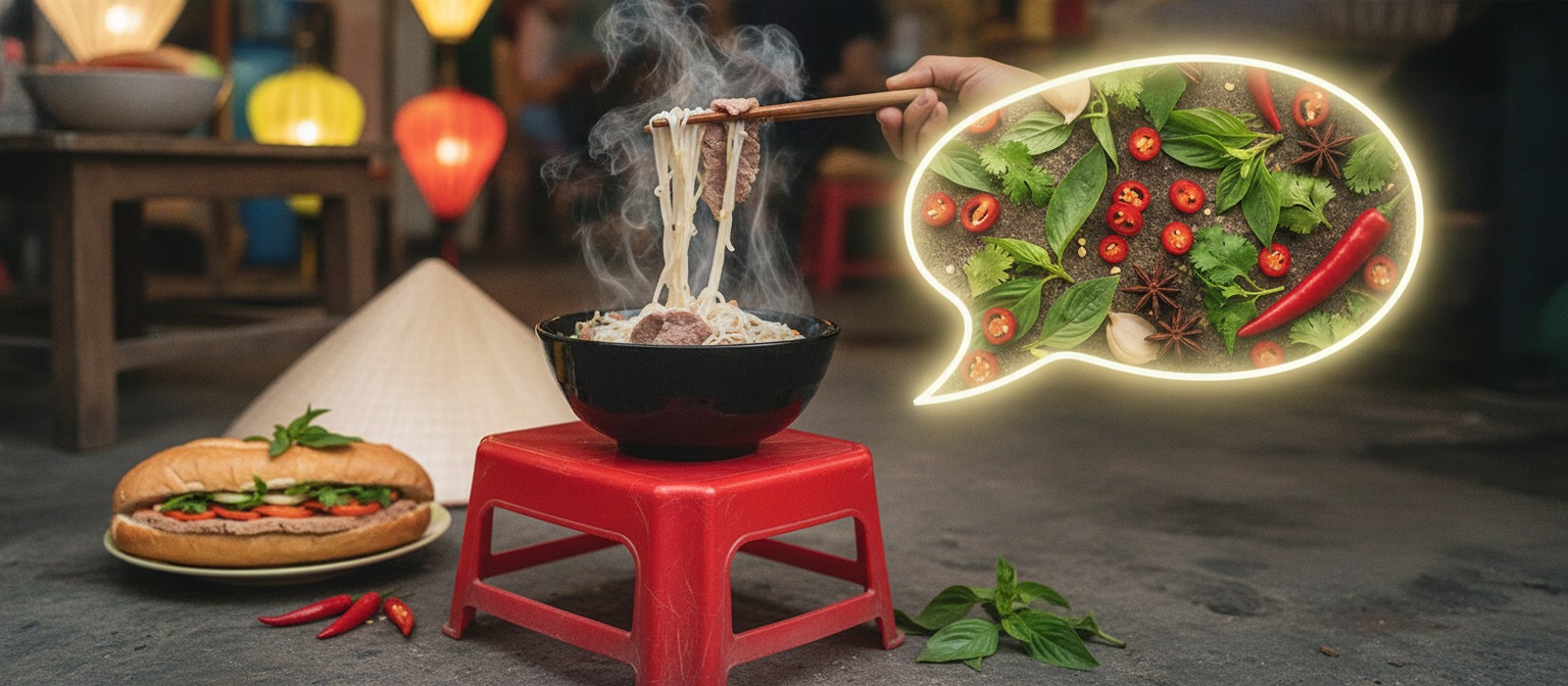
Vietnamese food recommendation slang is the set of short, informal phrases Vietnamese speakers use to ask where to eat, to praise a dish and to warn each other off a bad one. Most of it is built from ordinary words like ngon (delicious) and ghiền (hooked), and a handful of food names that have drifted into insults and flirting.
The catch for learners is that the same food word can be a compliment in one sentence and an insult in the next. This guide covers the phrases that work when you recommend or order food, the dishes people actually point you to by region, and the food slang that is not about food at all.
- 🎯 Ngon first, the plain word ngon carries most recommendations; slang only adds colour on top.
- 🌍 Regional dishes, Southern, Central and Northern menus differ, and so do the words around them.
- ⚠️ Food insults, bánh bèo, trà xanh and gà describe people, not meals, and can sting.
- 💡 Ordering lines, five short phrases cover seating, allergies, takeaway and the bill.
Here are the four layers of the topic, in the order you will meet them: how people ask and praise, how you order what they recommended, which regional dishes they mean, and which food words to keep away from people.
How do Vietnamese speakers recommend food in everyday conversation?
Vietnamese speakers recommend food mostly with the adjective ngon (delicious) and a few fixed expressions around it. A direct question like "Quán nào ngon?" (which place is good?) is normal between friends, and the answer is usually a place name plus one short verdict. The vocabulary is small, which is why the tone and the register matter more than the word list.
What does "ngon bổ rẻ" really mean?
Ngon bổ rẻ literally means "tasty, nourishing, cheap". In practice it is the stamp of approval for a cheap local place where the food is good and the bill is small, and it shows up constantly in food reviews and group chats. It is friendly and informal. Use it with friends, colleagues and family, and it will not offend anyone, though it sounds too casual for a formal dinner with a client.
Can you use "đỉnh của chóp" for food?
Yes. According to the HowToVietnamese lesson on modern slang, đỉnh của chóp literally means "top of the top", since both đỉnh and chóp mean the highest point of something. It works as an adjective for anything of top quality, so "Phở này đỉnh của chóp!" (this phở is top of the top) is a natural compliment. It belongs to young speakers and the internet. Said to an older relative or a boss, it risks sounding like you are not taking the meal seriously.
How do you say a dish is addictive, and does it differ by region?
Ghiền means "hooked" or "addicted", and "Ăn là ghiền" (eat it once and you are hooked) is a common way to say a dish is irresistible. Ghiền is the Southern form of the word that Northern speakers write and say as nghiện. Both appear in food talk, so a Saigon friend and a Hanoi friend can recommend the same bowl with two different words. Keep it to food and habits you are joking about: said about a real addiction, the word is serious.
Rule of thumb: ngon is safe everywhere, and every other word needs an audience.
What about "mlem" and "xu cà na"?
Mlem is an internet sound word for the satisfied smack of lips over food, popular with Gen Z in captions and comments. Its origin is not documented well enough to state with confidence, so treat it as pure online register: fine in a comment, odd out loud to someone's grandmother.
For a bad recommendation, the video from HowToVietnamese explains xu cà na, an exclamation for bad luck. Cà na is a very sour fruit, and "xu" has no meaning of its own: it only echoes xui, the Southern word for unlucky. When a restaurant a friend recommended turns out to be a letdown, "xu cà na" is the playful reaction. For more of this register, the Gen Z slang guide decodes what young speakers say and what it really means.
How do you order the dish someone just recommended?
To order a recommended dish in Vietnamese you need five short moves: ask for a table, call the staff, state your restrictions, choose between eating in and takeaway, and ask for the bill. The Lily's Travel Agency video on ordering food in Vietnam builds the whole exchange from these pieces, and each one is a sentence you can reuse the same evening.
Which words get you a table and the staff's attention?
For a table, the pattern is "Cho mình một bàn hai người" (give me one table, two people), and you swap the number for your group. To call a waiter, waitress or owner, add "ơi" after the address word: anh ơi (to an older man), chị ơi (to an older woman), em ơi (to someone younger) or bạn ơi (to a peer). The video gives the pronoun logic: "mình" is "me" between peers, "em" says you are younger than the listener, and anh and chị mark the person you address as older. The full system is in who gets anh, chị, cô or chú, and picking the wrong one is the commonest mistake at a restaurant door.
How do you say "no chilli" or "no fish sauce"?
Start with không (no). The video lists không cay (not spicy), không lạc (no peanuts, the Northern word), không nước mắm (no fish sauce) and không mì chính (no MSG). Southern speakers say đậu phộng for peanut, so a server in Saigon may repeat your request with that word. Because fish sauce sits in many dipping sauces, the allergy phrase deserves repeating when the dish arrives.
How do you ask for takeaway and the bill?
Staff will ask "Ăn tại chỗ hay mang về?" (eat here or take away?). Answer "Cho mình mang về" or, if you are younger, "cho em mang về". At the counter the video uses "Bạn ơi, cho mình thanh toán nha" (could I pay, please). It also gives "bao nhiêu tiền" (how much money) as a simple way to ask the price, and flags that it is easy but not the most polite option, so add ạ at the end to soften it. If the number you hear seems inflated for a foreigner, nói thách explains the word behind that.
Delivery apps remove the spoken part altogether. Lily's Travel Agency names Grab, ShopeeFood and Be as the three most popular, and the HowToVietnamese food listening lesson puts the wait at about 30 to 50 minutes.
Which regional dishes do locals actually recommend?
Vietnamese people recommend dishes by region first, because the same word can mean a different bowl in the North, the Centre and the South. The HowToVietnamese listening lesson names specific dishes for each part of the country, and a recommendation almost always comes with a place of origin attached.
According to that lesson, the South has cơm tấm, hủ tiếu and bánh xèo. The Centre has mì Quảng, bún bò Huế and cơm hến. The North has bún đậu mắm tôm and bún thang. The table below keeps five of them with the details you need when someone says "you have to try it".
| Dish | Region | What it is | Note when ordering |
|---|---|---|---|
| Cơm tấm | South | Broken rice, usually with grilled meat | Common at breakfast and lunch in Saigon |
| Bánh xèo | South | Crispy filled pancake, named after the sizzle | Eaten wrapped in herbs and dipped |
| Mì Quảng | Centre | Noodles with a small amount of broth | Regional pride; Northerners may not know it |
| Bún bò Huế | Centre | Spicy beef noodle soup from Huế | Say không cay if you want it mild |
| Bún đậu mắm tôm | North | Vermicelli, fried tofu and fermented shrimp paste | The paste smells strong; ask for it on the side |
SOURCE : HowToVietnamese, FOOD listening practice (YouTube) · MAJ 10/2026
Is a Vietnamese meal one dish or several?
Several. The HowToVietnamese lesson describes a typical family meal as four parts: rice, soup, a main dish of meat or seafood, and vegetables that are boiled or stir-fried. Rice is the centre, which is why cơm means both "cooked rice" and "a meal" in everyday speech, and why "Ăn cơm chưa?" (have you eaten rice yet?) is a greeting as much as a question. The same dishes are eaten at breakfast, lunch or dinner, per the lesson.
What do English-language reviewers add to this?
The Beryl Shereshewsky video, in which Vietnamese American viewers choose dishes for her, shows what a recommendation sounds like from the inside: one guest describes canh chua as a sour tamarind soup full of vegetables, another explains bún thịt nướng as rice vermicelli with lemongrass pork. One guest points out the name of bò lúc lắc: lúc lắc is an onomatopoeia for shaking, which is what the cubes of beef do in the hot pan.
A thread on r/FoodNYC adds a counterweight. A Vietnamese poster ended a four-year list of New York restaurants by arguing that what they crave is "Vietnamese Vietnamese food, not Vietnamese American food", comparing the best local spots to Diet Coke next to the original. That is one person's opinion, not a ranking, but it explains why recommendations from Vietnamese friends often come with the words "ở Việt Nam" (in Vietnam): they may be praising a taste the restaurant abroad cannot copy.
A recommendation without a region is half a recommendation: ask "Món miền nào?" (which region's dish?).
Which food words describe people instead of meals?
Several Vietnamese food words describe people, and they carry real risk. Bánh bèo, trà xanh, gà and thả thính are all food or kitchen images used for behaviour, which is why they are hard to detect in a conversation about dinner.
According to a guide on note.com dated April 7, 2026, Vietnamese culture places great importance on eating, so comparing the texture, look or taste of food to a person's character comes naturally and makes the joke land immediately.
Why is "bánh bèo" an insult and not a snack?
Bánh bèo is literally a Huế specialty: a small steamed rice cake made from rice flour and tapioca flour, soft and wobbly. As slang it means a girly, coy or dependent woman. The note.com guide says the term originated among gay men mocking women and is now widely used by young people, with the example "Con bé đó bánh bèo lắm" (that girl is so coy).
Register warning: among close friends it can be teasing. Said to or about a woman at work, in front of her family, or to someone who does not already joke this way, it is a put-down. Foreigners should avoid it entirely until they hear locals use it first.
What is "trà xanh" and why is it worse?
Trà xanh literally means "green tea". The HowToVietnamese slang lesson defines it as a girl who looks innocent but is calculating, intending to steal someone else's partner. It is a hostile label. Use it only to understand what you read online. Never say it to the woman, her partner or in a group where she has friends.
What do "gà" and "thả thính" mean?
Gà literally means chicken. The note.com guide uses it for someone who is inexperienced or weak at something ("Wow, he is so gà"), and it appears constantly in gaming. It is friendly between peers who play together and rude when aimed at someone who is trying to learn. The same guide explains thả thính: "thả" means to cast and "thính" is rice-flour fish bait, so the phrase means to flirt or throw out hints of romantic interest. It is light and common among young speakers, though flirting with a colleague at work still has its own consequences.
A related online phrase is phát cẩu lương, literally "to hand out dog food". The HowToVietnamese lesson uses it for couples showing affection in front of single people. It is mild and jokey among friends.
What about the proverb "ăn cơm nhà vác tù và hàng tổng"?
Here the sources disagree. The Talkpal page, which ranks first on Google for this topic, translates the proverb as "eat at home rice, carry the communal gun" and reads it as someone who enjoys home comforts but takes on communal burdens. The word tù và is a horn, not a gun, so the literal image is "eating rice at home, blowing the village horn". The sense that Vietnamese speakers give it is doing unpaid work for the community at your own cost. Talkpal is right about the burden and wrong about the object.
The same Talkpal page lists ăn nem ("eat spring rolls") as slang for flirting or having an affair. None of the other sources here confirm that meaning, so this guide does not recommend using it. Learn the dictionary entry before you test it on anyone.
Once the food words are sorted by what they cost to say, the next step is hearing them in context: the slang dictionary on Vietslang lists each word with its register and region.
What should you actually say at your next Vietnamese meal?
Say ngon and nothing fancier, until you know who is listening. For asking, use "Quán nào ngon?". For praise among friends, use "ngon bổ rẻ" or "ghiền" (Southern) or "nghiện" (Northern). For ordering, use "Cho mình một bàn hai người", "không cay" and "Cho mình thanh toán nha". Save bánh bèo, trà xanh and gà for reading, not speaking.
The Northern and Southern forms split in more places than ghiền and nghiện. If you want to hear how, the guides on the Southern dialect of Saigon and the Northern dialect show where the same dish goes by different sounds. For wider economic and regional background on Vietnam, the country data published by the OECD is a reliable place to start.
FAQ
What is the most common Vietnamese word for "delicious"?
Ngon is the most common word for delicious in Vietnamese, and it works for food, drink and, loosely, anything good. It is neutral in register, so it is safe with strangers, elders and colleagues in every region. Slang like "đỉnh của chóp" or "ghiền" can be added between friends.
How do you ask for a restaurant recommendation in Vietnamese?
Ask "Quán nào ngon?" (which place is good?) or "Gợi ý cho mình quán nào với" (suggest a place for me). Add the dish or the area, for example "gần đây" (nearby). Use the pronoun that fits the listener's age: mình with peers, and anh or chị with someone older.
Is "bánh bèo" a compliment or an insult?
Bánh bèo is a Huế steamed rice cake and also slang for a coy, dependent woman. According to a note.com guide, it began as mockery and is now widely used by young speakers. Treat it as an insult unless you know the speaker's circle jokes this way.
Do Northern and Southern Vietnamese use different food words?
Yes. Examples in the sources: Southern ghiền versus Northern nghiện for addicted, and Southern đậu phộng versus Northern lạc for peanut. Dishes also differ, with cơm tấm and bánh xèo in the South, bún bò Huế in the Centre and bún đậu mắm tôm in the North.
Can you rely on a delivery app instead of speaking Vietnamese?
For ordering, yes. Grab, ShopeeFood and Be are the three popular apps named by Lily's Travel Agency, and delivery takes roughly 30 to 50 minutes according to HowToVietnamese. For recommendations and jokes at the table, the apps do not help.
Sources
- What do Vietnamese People Order in a Vietnamese Restaurant? — Beryl Shereshewsky
- Vietnam Travel Tips | How to order food in vietnam? — Lily's Travel Agency
- 5 Must-know Modern Slang in Vietnamese — HowToVietnamese
- FOOD - Listening Practice in Slow Vietnamese — HowToVietnamese
- Food Slang in Vietnamese Language — talkpal.ai
- A Complete Guide to Vietnamese Food Slang — note.com
- My Top List for Vietnamese Food in NYC (from a Vietnamese) — r/FoodNYC