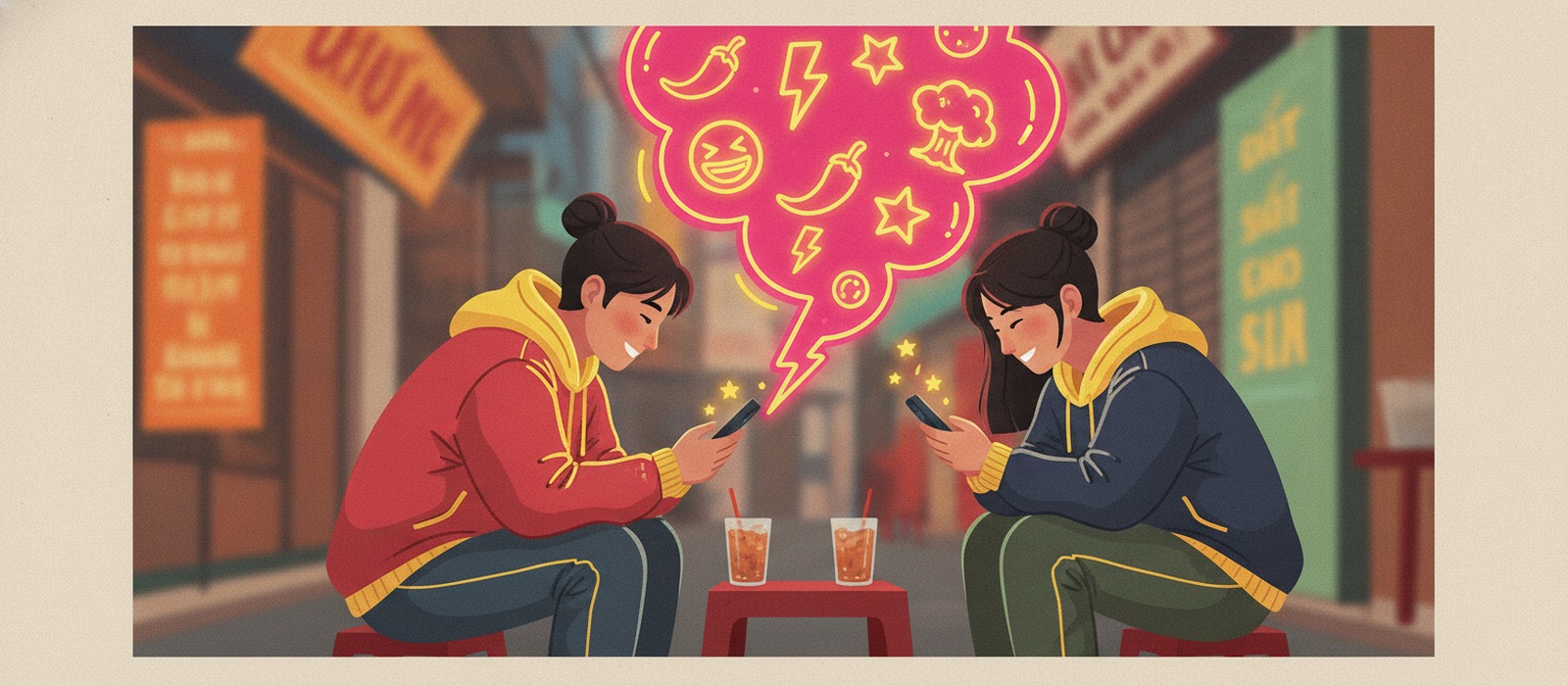
Vietnamese tech slang youth actually type looks nothing like what a phrasebook teaches. When a video call freezes or a router needs a restart, a Vietnamese Gen Zer does not reach for formal vocabulary: the phone gets tapped, a friend gets tagged, and a word like đứng hình or toang lands in the chat instead. Each of these words carries a specific meaning and a specific risk that a literal translation completely misses. This piece decodes the ones that show up most often when technology breaks, when a game goes wrong, and when a Vietnamese teenager wants to complain about it without sounding formal.
- 📱 Wifi trouble gets its own words, đứng hình and khởi động lại show up before any English tech term does.
- 🎮 Gaming keeps its English, AFK, GG, and grind sit untouched inside otherwise Vietnamese sentences.
- ⚠️ Register decides everything, khum charms a close friend, cà khịa can start a real argument with a stranger.
- 🔑 The literal meaning is a trap, toang and ăn hành both hide an old, unrelated image nobody thinks about anymore.
What Vietnamese Youth Type When a Screen or Router Dies
When a stream freezes or a router stops responding, Vietnamese speakers do not say the screen "stopped working." They say it đứng hình. Đứng hình means, word for word, "standing image": a frame that stopped moving. The real meaning is broader than a frozen video call. It covers a screen that froze, an app that crashed mid-use, or a face that went blank from shock, and Vietnamese youth use all three senses interchangeably in a group chat.
A skit shared on the subreddits r/HocTiengviet and r/learnvietnamese by creator Ngân of Langiri walks through exactly this scenario: a television freezing mid-movie, then a call to customer support. The vocabulary that comes out of it is functional, not slangy, but it is what actually gets typed before anyone reaches for English. Tổng đài (literally "switchboard") means the customer support hotline. Nhấn nút nguồn means to press the power button. Khởi động lại means to restart the device. None of these carry any risk of offense: they are safe in a message to a landlord, a telecom hotline, or a boss whose home internet just died mid-meeting.
What does đứng hình actually mean?
Đứng hình describes anything that stopped moving when it should not have: a frozen livestream, a crashed app, or a person too stunned to react. In a tech context it is the word for "it froze," used the moment a screen stops responding rather than after the fact.
The Gaming Vocabulary That Slides Into Vietnamese Untranslated
Vietnam counted more than 78 million internet users by early 2024, according to Statista, and a large share of that audience is under 35, the exact age band that spends its evenings in game lobbies rather than on formal Vietnamese classes. Vietnamese gamers do not translate their gaming vocabulary; they keep it in English and drop it straight into Vietnamese sentences. A video from the channel Vietnamese Sticker Teacher, titled "Learn Vietnamese - Gaming Vocabulary Terms You Need To Know," runs through exactly this pattern: AFK (away from keyboard), GG (good game), glitch or bug, grind, and clan or guild all get said in English while the rest of the sentence stays Vietnamese. A Vietnamese teenager will text "tao AFK 5 phút" (I'm AFK for 5 minutes) without a second thought, because the borrowed word is faster than any Vietnamese equivalent and every other player already understands it.
Not every gaming word stays neutral, though. Trẻ trâu literally means "young buffalo, " and its real meaning is an immature kid who acts out for attention, usually in a lobby chat or comments section. According to slangloom.com, the term applies to both Gen Z and to anyone behaving in a childish way online, and its tone is mocking, not neutral. Calling someone trẻ trâu to their face in a work chat reads as an insult, not a joke, it belongs in a private complaint about a stranger's behavior, never as a direct message to a colleague or a customer.
Why do Vietnamese gamers keep English words like AFK and GG?
Vietnamese gaming culture absorbed its vocabulary directly from international servers and English-language streamers, so terms like AFK, GG, and grind arrived already attached to a precise, shared meaning. Translating them would slow down a match; keeping the English word lets every player, regardless of dialect, understand instantly.
The Reactions Vietnamese Youth Type When Something Goes Wrong Online
A dropped livestream, a lost match, or a scam link opened by mistake all get the same family of reactions in a Vietnamese group chat, and none of them describe the event literally. Toang means a situation fell apart completely: an exam failed, a deadline missed, a livestream that crashed at the worst moment. Migaku.com lists toang as one of the most common Gen Z reactions to exactly this kind of failure, and it carries no literal translation worth mentioning: the word simply means "it's screwed."
Ăn hành sits one layer deeper. It literally means "eating onion," but according to the same source, its real meaning is getting trolled, pranked, or tricked, often after clicking a fake link or falling for a joke in a group chat. Someone whose account just got hacked through a scam message might type "tao ăn hành rồi" (I got played) instead of explaining what happened. Bó tay, literally "tied hands," means being speechless or completely out of options: a fitting reaction to a router that will not restart no matter what gets pressed. Căng, literally "tight" or "tense," describes a situation turning serious or dramatic, the kind of word that lands when an argument breaks out in the comments under a tech complaint.
None of these four carry a real offense risk on their own, they describe frustration, not people, but căng and toang both sound too casual for a formal report to a manager, even one about a genuine outage.
What does toang mean when a livestream crashes?
Toang means the situation is ruined or has completely fallen apart. Applied to a livestream, it means the broadcast crashed badly enough that recovering it mid-stream is not realistic, and the streamer or the audience types it the moment the feed dies.
The Softening Words That Keep a Tech Complaint Friendly
Some Vietnamese youth slang exists purely to soften a complaint, and three of them show up constantly around broken tech and failed plans. Khum is a playful stand-in for không (no), pronounced close to the original word but stretched into something cuter. According to Vietcetera, typing khum instead of không signals closeness: it is how a Vietnamese teenager tells a close friend "no, the wifi still isn't back" without sounding blunt.
U là trời, a shortened way of expressing shock, functions like "oh my god" when a screen suddenly goes dark. J dz trời, an abbreviation of "Gì vậy trời?" (what's going on, or literally "oh god, what is it"), carries a mix of surprise and mild irritation, and Vietcetera notes it mimics the relaxed consonants of the Saigonese, southern Vietnamese accent specifically. A Hanoi speaker is more likely to type or say the fuller "gì vậy trời" rather than the clipped southern version, which is a real North-South split worth knowing before copying either spelling. Gato, from ghen ăn tức ở (roughly, jealous to the point of resentment), gets typed the moment someone posts a new phone or a gaming setup upgrade: it means envious, and per migaku.com, it is one of the most reliable comments under exactly that kind of post.
None of these four should go anywhere near a boss, a client, or a customer support agent. Khum and u là trời both read as childish outside a peer group, and typing them in a work chat about a broken company laptop would sound like a teenager talking to a manager, not an employee reporting an issue.
Is it OK to type khum or u là trời to a boss?
No. Khum and u là trời both signal closeness and casual affection, which makes them appropriate with friends, siblings, or a romantic partner but genuinely inappropriate in a message to a boss, a teacher, or a client. The safer register for those relationships is the plain không and the full, uncontracted sentence.
| Term | Literal meaning | Real meaning | Safe with |
|---|---|---|---|
| Đứng hình | Standing image | Screen froze, or a person stunned into silence | Anyone, including customer support |
| Toang | No standalone literal sense | A situation fell apart completely | Friends and family, not a formal report |
| Ăn hành | Eating onion | Got trolled, pranked, or scammed | Friends, when self-describing the mistake |
| Khum | Playful stretch of "không" (no) | A cute, close-friend way to say no | Close friends only, never a boss or client |
| Trẻ trâu | Young buffalo | An immature kid acting out online | Describing a stranger, never said to someone's face |
SOURCE : vietcetera.com, migaku.com, slangloom.com · Updated 09/2026
Reading these five side by side makes the pattern clear: the literal meaning almost never predicts the real one, and the safe audience shrinks fast once a word turns mocking or overly familiar. Anyone building a habit of decoding Vietnamese tech complaints benefits from the same approach used for Vietnamese gaming slang elsewhere, where borrowed English words sit next to homegrown ones with completely different register rules.
Cà khịa belongs in this same caution zone. It means playful teasing or light sarcasm among friends, the kind of jab that follows a lost match or a bad take, but the same word aimed at a stranger, or worse, at a customer support agent stuck on hold with a broken router, reads as picking a fight rather than joking around. The full picture of which Vietnamese slang words locals actually use every day carries dozens of similar cases where the difference between funny and rude comes down entirely to who is on the other end of the chat.
The common thread across every term above is that Vietnamese youth type feelings and reactions before they type facts. A broken router gets a reaction word (toang, bó tay) before anyone types "the router is broken." That habit is worth remembering for anyone reading Vietnamese chats: the emotional word usually arrives first, and the literal explanation, if it comes at all, follows several messages later. Learners chasing the wider vocabulary shift behind this, including the teencode and abbreviations that replace whole phrases in Zalo and Messenger, will recognize the same rule: read the register before repeating the word. Anyone who wants to test these words risk-free, with the register attached to each entry, can browse the slang dictionary: every word with its register and region before trying one out on a Vietnamese friend.
FAQ
What is Vietnamese tech slang, exactly?
Vietnamese tech slang is the informal vocabulary Vietnamese speakers, mostly Gen Z, use to describe technology breaking, gaming going wrong, or an online reaction to either. It mixes borrowed English gaming terms like AFK and GG with homegrown words like đứng hình and toang, and it almost never matches the vocabulary taught in a Vietnamese textbook.
Why do Vietnamese gamers use English words instead of Vietnamese ones?
English gaming terms like AFK, GG, and grind arrived through international game servers and English-language streamers already carrying one precise meaning understood by every player. Translating them into Vietnamese would add a step without adding clarity, so the community kept the English words as they were.
Is it rude to call someone trẻ trâu?
Yes, in most contexts. Trẻ trâu mocks someone for acting immature, and while it is common to describe a stranger's behavior online, saying it directly to a colleague, a customer, or an elder is read as an insult rather than a joke.
What does ăn hành mean if a friend types it after a scam link?
Ăn hành means getting tricked, pranked, or trolled. A friend typing "tao ăn hành rồi" after clicking a fake link is admitting they got played, not describing food, and the phrase carries no real accusation toward whoever sent the link.
Do Northern and Southern Vietnamese youth use the same tech slang?
Mostly the same core words, but pronunciation and shortcuts differ. J dz trời specifically mimics the relaxed consonants of the Saigonese, southern accent, while a Northern speaker is more likely to type or say the fuller "gì vậy trời" instead of the clipped southern spelling.
Sources
- Learn Vietnamese - Gaming Vocabulary Terms You Need To Know — Vietnamese Sticker Teacher
- A Beginner's Guide To Vietnamese Gen-Z Internet Slang — vietcetera.com
- Vietnamese Internet Slang: Popular Terms Gen Z Actually Uses — migaku.com
- Vietnamese Slang: The Ultimate 2K26 Guide to Modern Street Talk & Online Lingo — slangloom.com
- WiFi Dropped at the Best Part?! Learn Vietnamese Technical Slang & Tech Words — r/HocTiengviet
- WiFi Dropped at the Best Part?! Learn Vietnamese Technical Slang & Tech Words — r/learnvietnamese