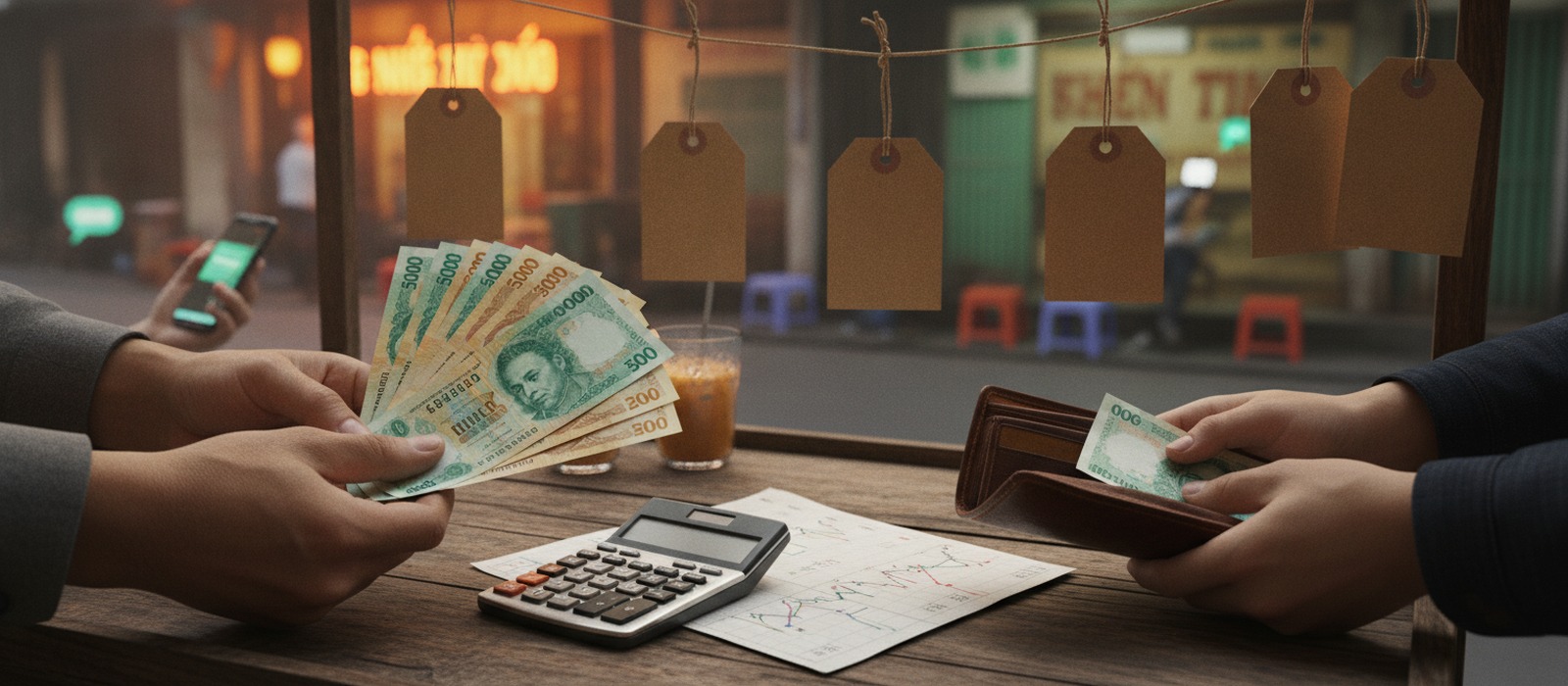
Tourist money negotiation slang in Vietnam is not one phrase, it is a small vocabulary that describes the whole ritual: the inflated first price, the accusation of getting cheated, and the words locals use to pull the number back down. None of it appears in a phrasebook, because phrasebooks teach trả giá (to bargain) and stop there, as if haggling in Vietnam were a single polite transaction instead of a coded exchange both sides expect.
- 💰 Nói thách, the inflated "first offer" a seller expects you to reject.
- ⚠️ Chặt chém, literally "to chop, " slang for openly ripping off a customer.
- 🗣️ Trả giá / bớt, the actual words locals use to push a price down.
- 🌍 North vs South, the same haggle sounds different in Hà Nội and Sài Gòn.
Why the price already has two versions before you say a word
Nói thách (literally "to say a challenge" or "to dare") is the Vietnamese term for a seller quoting a price they know is inflated, on purpose, as the opening move of a negotiation. It is not lying in the Western sense: both seller and buyer understand the quoted number is a starting point, not the price anyone expects to pay.
The companion term is giá Tây, literally "Western price, " the higher figure quoted specifically to a foreign face. A T-shirt that costs a Vietnamese shopper 80,000 VND at Chợ Bến Thành in Ho Chi Minh City might open at 200,000,250,000 VND for a tourist, and the seller will not consider this dishonest. The gap exists because nói thách assumes everyone negotiates, and a foreign buyer is assumed to negotiate less.
Is nói thách considered rude to point out?
No. Naming it out loud, even in English, tends to get a smile rather than offense, because sellers know tourists eventually learn the term. Saying something close to "nói thách quá" ("that's too much of a dare-price") signals you know the game, which alone can shift the opening number on the next item.
Compare this to Chinese market culture, where the equivalent opening move is folded into general bargaining etiquette rather than named separately: according to a May 2025 guide from thatsmandarin.com, the standard opening complaint is simply "太贵了" (tài guì le, "it's too expensive"), used as a blanket phrase rather than a term for the inflated quote itself. Vietnamese splits the concept into its own word, which is why nói thách is worth learning even before you learn how to counter it.
The word for getting ripped off, and how far it goes
Chặt chém means, literally, "to chop and hack," and its real meaning is aggressive overcharging, usually of tourists, at a level that goes beyond the normal nói thách cushion. A drink priced at 15,000 VND for locals sold at 150,000 VND to a tourist at a beach stall is chặt chém, not ordinary haggling room.
A stronger version is cắt cổ, "to cut the throat," reserved for the worst cases: taxi meters rigged to run fast, seafood weighed with a thumb on the scale, a "service fee" invented on the spot. Vietnamese news outlets use cắt cổ in headlines about tourist scam crackdowns, so the word carries a note of scandal that nói thách does not.
The distinction matters because reacting to nói thách with outrage misreads a normal negotiation as an insult, while accepting chặt chém as normal means overpaying by multiples, not percentages. Locals draw the line roughly at "double the going rate is a bargaining opener, five or ten times is chặt chém."
How do you recognize chặt chém before you pay it?
The clearest sign is the absence of a displayed price (giá niêm yết) combined with a refusal to state one until after the item is prepared or the service is finished, common at unmarked seafood stalls and unmetered motorbike taxis. Asking "bao nhiêu tiền" (how much) before ordering, and waiting for a number before nodding, removes most of the risk.
How locals actually talk a price down
The base verb is trả giá, literally "to pay/offer a price," meaning to bargain. Vietnamese shoppers rarely accept the first number silently; they counter with roughly half of what was quoted and let the seller walk it back up.
The single most common word during that walk-back is bớt, "to cut" or "reduce." "Bớt chút đi" ("cut a bit, will you") is the standard phrase said while handing over cash, often as the final word before the deal closes, not the opening one.
Sellers have their own aggressive counter-move: hét giá, "to shout a price," used when a seller responds to a lowball offer with a dramatically higher restated number, sometimes literally raising their voice, to signal the buyer's offer was insultingly low. And làm giá, "to make a price," describes a seller who deliberately manufactures a high asking price purely to have room to "discount" it back to what they wanted all along, a tactic identical to the "was $99, now $49" trick used in retail worldwide.
A useful reading in English: enGrab's business-English tutorial on price negotiation teaches phrases like "is that the best you can do" and "we can meet each other halfway," and both translate almost word for word into the Vietnamese market exchange. Pairing the English phrase with a Vietnamese number, said with a smile, works better in most Ho Chi Minh City or Hanoi markets than either language alone.
What is the safest opening counter-offer?
Offering roughly 40 to 50 percent of the nói thách price is the common local starting point, adjusted upward or downward as the seller reacts. Offering the full asking price, or something close to it, tends to signal a tourist who has not learned that the first number was never meant to be paid.
| Term | Literal meaning | Real meaning | Where you'll hear it |
|---|---|---|---|
| Nói thách | To say a dare | Deliberately inflated opening price | Any street market, souvenir stall |
| Giá Tây | Western price | Higher price quoted to foreigners | Tourist zones, Chợ Bến Thành, Old Quarter Hanoi |
| Chặt chém | To chop, to hack | Overcharging well beyond normal bargaining | Beach resorts, unmetered taxis |
| Bớt | To cut | Asking for a small final discount | Markets, right before paying |
| Hét giá | To shout a price | Seller's angry counter to a low offer | Markets, when an offer is too low |
| Làm giá | To make a price | Manufacturing a high price to fake a discount | Souvenir shops, boutiques |
SOURCE : transcripts cités · MAJ 09/2026
North, Center, South: the same haggle, different words
Bargaining vocabulary shifts by region the way most spoken Vietnamese does. In Hanoi and the North, bớt dominates as the word for "cut the price," said softly and often paired with anh/chị ơi to soften the ask. At Chợ Đồng Xuân, Hanoi's largest traditional market, a full negotiation can happen almost entirely through the single word bớt repeated with different tones of urgency.
In Ho Chi Minh City and the South, the vocabulary is closer to the same core words, but the pace is faster and giảm giá ("reduce the price," a more neutral, almost formal-sounding cousin of bớt) gets used more often in fixed-price shops that still allow a small discount, as opposed to open-air markets where bớt stays dominant.
Central Vietnam, particularly Huế and Đà Nẵng, tends toward more indirect phrasing, softening a bargaining request behind a question about whether "there's any way" the price could be lower, rather than a flat "bớt đi." A phrase that lands as normal haggling in Saigon can read as pushy in Huế without that extra layer of politeness.
Does the same haggling word work the same way in every city?
Not reliably. The literal vocabulary (bớt, nói thách, trả giá) is understood everywhere because national media and southern-dominated pop culture have spread it nationwide, but the acceptable tone, volume, and how many rounds of counter-offers are polite differ by region. Copying a Saigon market's brisk, joking haggling style word-for-word in a smaller Central Vietnam town can come across as impatient rather than playful.
Vietnam recorded roughly 12.6 million international visitor arrivals in 2023, according to data compiled by Statista, a volume large enough that most heavily touristed markets have priced their opening "nói thách" numbers specifically around what a first-time foreign visitor is expected to accept without question. That scale is exactly why the vocabulary above exists as a named, shared system rather than ad hoc haggling: sellers and buyers on both sides have run the exchange thousands of times.
For the vocabulary that surrounds daily life outside the market stall, Vietnamese Slang Words Locals Actually Use Every Day covers the register question in more depth, and Viet Slang Decoded: What Gen Z Says and What It Really Means is the closer companion piece for anyone hearing these same negotiation instincts applied to online marketplaces and secondhand app deals.
Foire aux questions
Is bargaining considered rude in Vietnam?
No, bargaining is the expected mechanic in open-air markets, street stalls, and most souvenir shops, and skipping it usually means paying the nói thách price in full. It is not expected, and can look odd, in supermarkets, chain stores, or anywhere with a printed price tag (giá niêm yết), where the number is fixed.
What is chặt chém and why does it target tourists specifically?
Chặt chém describes overcharging well beyond the normal bargaining range, not the standard opening markup of nói thách. It targets tourists because unfamiliarity with local prices, combined with limited Vietnamese, makes it harder to notice or contest an inflated number in the moment.
Will using Vietnamese bargaining slang actually get a real discount?
It usually shifts the starting point of the negotiation rather than guaranteeing a specific discount. Saying "bớt chút đi" or naming nói thách out loud signals familiarity with the local system, which sellers tend to respond to with a smaller opening markup on the next item, even if the very first exchange stays close to the tourist rate.
Is negotiating different in Hanoi compared to Ho Chi Minh City?
The core words are the same, but the pace and tone differ: Hanoi and northern markets favor a softer, repeated "bớt" said gently, while Ho Chi Minh City's markets move faster and allow more back-and-forth rounds before a deal closes. Central Vietnam, including Huế and Đà Nẵng, tends to expect more indirect, politer phrasing around the same request.
What is the one Vietnamese phrase a tourist should learn first for bargaining?
"Bớt chút đi" (cut it down a bit) is the single most useful phrase, because it works as a closing line in almost any market transaction regardless of region. Pairing it with a specific counter-number, rather than saying it alone, gets a faster and more concrete response from most sellers.