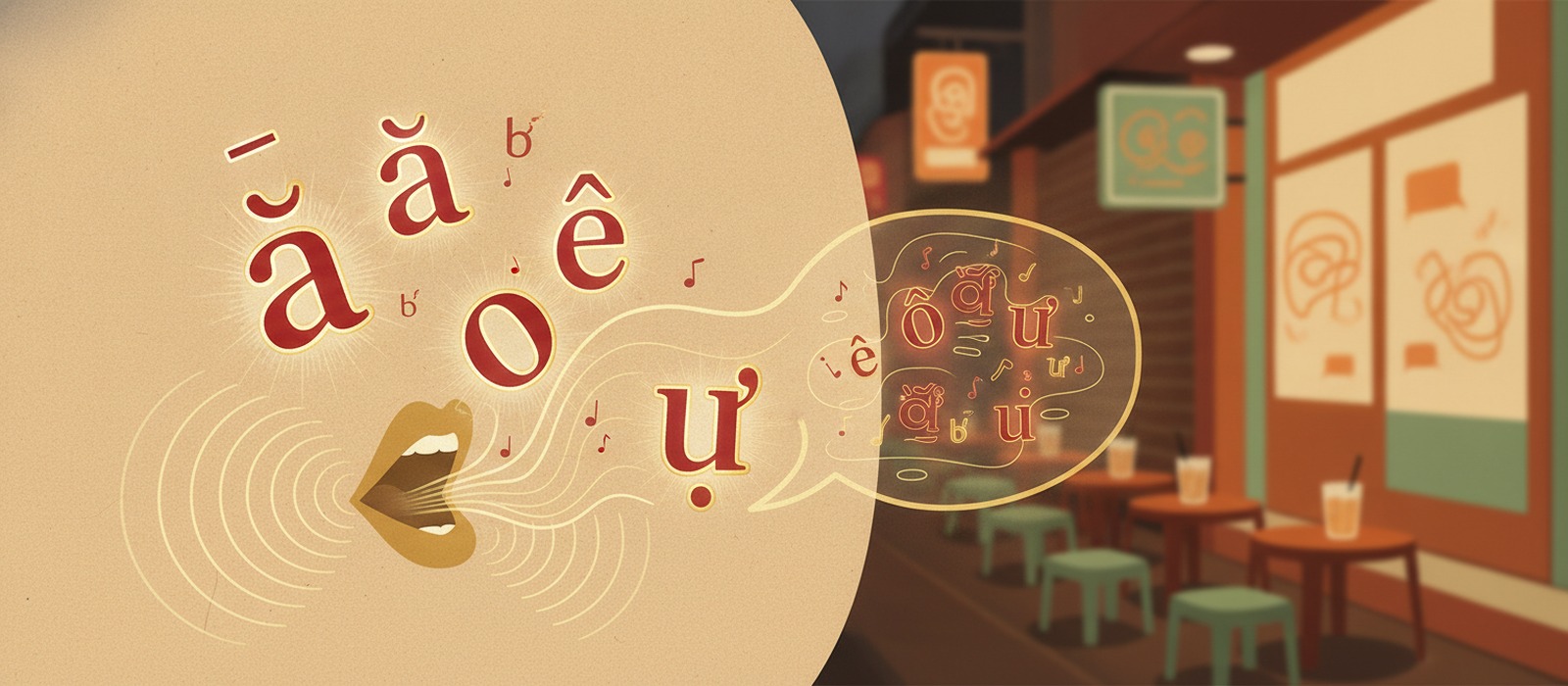
Vietnamese vowels pronunciation breaks down for almost every English speaker at the exact same six letters: ă, â, ê, ô, ơ, and ư. These are not decorated versions of a, e, o, and u with an accent mark bolted on for style. Vietnamese treats them as twelve fully separate vowel letters, each with its own mouth shape, and English simply does not have equivalents for four of them.
- 📊 12 independent vowels, ă, â, ê, ô, ơ, and ư are separate letters in Vietnamese, not accented versions of a, e, o, and u.
- 🗣️ Mouth shape beats memorizing rules, most mispronunciation comes from copying the sound instead of the mouth position that produces it.
- 🌍 North and South differ, the same vowel can shift slightly between Hanoi and Saigon speech, and dictionaries usually only teach one of them.
- 🎯 "Tròn vành, rõ chữ", the Vietnamese expression for clear speech literally demands that the mouth physically move, not just that the ear know the rule.
That gap is where most self-taught pronunciation goes wrong. A learner sees "ơ" and reads it as "o," because that is what the eye defaults to. The mouth never learns the actual shape, and a Vietnamese listener hears a syllable that sounds close but not right. Below is a working breakdown of the twelve vowels in groups, the way native-speaking channels actually teach them.
Why Vietnamese vowels aren't just accented letters
Vietnamese uses the Latin alphabet, but its vowel inventory does not map onto English one-to-one. The standard set of single vowels is a, ă, â, e, ê, i, o, ô, ơ, u, ư, and y, twelve letters in total, according to the pronunciation reference at openbooks.lib.msu.edu. Six of them carry a diacritic mark (ă, â, ê, ô, ơ, ư), but that mark does not modify a base sound the way an accent does in French or Spanish. It signals a completely different vowel.
What makes ă, â, ê, ô, ơ, and ư different from accented letters?
In dictionary ordering, ă is treated as its own letter, sorted separately from a, the same way b and c are separate letters and not variants of each other. The guide at vietnameselab.com makes this point directly: these six marked vowels are "independent letters, not decorated versions" of their unmarked counterparts. Reading ơ as a stylized o, or ư as a stylized u, guarantees a mispronunciation before the rest of the word is even spoken.
The three A's: a, ă, and â
Vietnamese has three A-sounds, and English speakers usually only produce one of them by instinct.
A is the wide-open vowel, close to the "a" in "father" or "harm." The mouth opens fully and the tongue stays relaxed. It shows up in a word like xa ("far").
Ă is shorter and tighter, closer to the "u" in "cut" or "much." The mouth opens less than for a, and the side of the tongue lightly touches the back teeth. It appears in mắt ("eye"), a word every beginner learns early and almost every beginner shortens incorrectly into a plain a.
 is the weakest and most unfamiliar of the three, roughly the "er" in "but" said without stress, a schwa-like sound. The lips, jaw, and tongue all relax at once. It shows up in đất ("earth" or "soil"). The three A's are not interchangeable, and swapping them changes the word, not just the accent.
How do a, ă, and â actually differ in the mouth?
The difference is timing and openness more than tone. A is long and wide, ă is short and slightly closed, â is short and centered with no real jaw movement at all. Listening drills that isolate minimal pairs, such as An, Ăn, Ân, are one of the few ways to train the ear to catch the gap before the mouth can reproduce it.
The two E's, the shared I/Y, and the three O's
Vietnamese doubles down on the same pattern with e and ê. E sounds close to the "e" in "red" or "bed," with the mouth stretched wide like a smile. Ê pulls the sound lower and softer, closer to the "ay" in "may" but without the English glide into an "ee" at the end, and the lips stay closer together. The pair shows up in hên ("lucky").
I and y are pronounced identically in modern Vietnamese, both landing on the "ee" sound in "me." The distinction between them is spelling, not sound, which is why yêu ("love") uses y instead of i in that position without changing how it's said.
Why does ơ sound nothing like any English vowel?
The three O's follow the same three-way split as the A's. O rounds the lips fully and sits close to the "aw" in "law," pronounced further back in the throat. Ô rounds the lips even more and pushes them slightly forward, closer to the vowel in "spoke." Ơ drops the lip rounding entirely: the mouth relaxes into something closer to the "ir" in "sir" or "bird," a sound that has no direct English single-vowel equivalent at all. It appears in trơn ("slippery"). Confusing ơ with o is one of the most common vowel errors among beginners, because the spelling looks related and the sound is not.
The two U's, and how North and South shift the sound
U rounds the lips fully, similar to "boo" in English, and shows up in bún (rice vermicelli noodles). Ư does the opposite: the teeth stay nearly closed and the lips stretch sideways instead of rounding forward, a sound with no real English match, landing somewhere close to an "uh" said with a flat, spread mouth. It appears in mứt ("jam" or candied fruit).
Vietnamese vowels pronunciation is not identical across the country. The guide at vietnamdaily.ca notes explicit variation "between the Northern/Capital dialect and the Southern dialect," and most lesson material, including standard textbooks, defaults to the Hanoi version without saying so. A Southern speaker's â or ơ can land in a slightly different place in the mouth than a Northern one, and consonant shifts compound the effect: one instructional video from Tieng Viet Oi notes that in everyday Northern speech, letters that are officially distinct, such as r and d, tend to collapse into the same sound, while Central Vietnamese speakers keep them apart. For learners focused on being understood in a specific region, that regional layer matters as much as the base vowel chart. A r/learnvietnamese post from the creator of vietsyllables.com describes adding a full Southern accent toggle to a syllable-drilling tool specifically because "the Saigon accent was very much needed," on top of the Northern pronunciation the site already covered.
Do Northern and Southern Vietnamese vowels sound different?
Yes, and the gap is wide enough that a chart built for Hanoi speech can mislead a learner living in Saigon or the Mekong Delta. The safest approach is to pick one regional target early, based on where the learner actually lives, works, or has family, and stay consistent, rather than mixing cues from Northern-focused videos and Southern-focused conversation. For a deeper look at how the Hanoi accent specifically diverges from the textbook standard, see the breakdown of the Northern Vietnamese dialect.
A vowel reference chart and how to actually practice it
Vietnamese speakers use a short phrase to describe what clear pronunciation requires: "Tròn vành, rõ chữ." As one learner explained in a widely shared r/learnvietnamese post, "tròn vành" means giving a sound its full physical shape, lips and jaw actually moving, while "rõ chữ" means the syllable comes out clear enough that a listener doesn't have to guess. The same post makes a point that matters more than any chart: a learner can know every rule in this article and still be misunderstood, because "knowing how a sound works and actually producing it are not quite the same thing." Small, lazy mouth movements are what make otherwise correct Vietnamese sound muffled to a native ear.
| Vowel group | Letters | Closest English sound | Mouth shape |
|---|---|---|---|
| The A's | a, ă, â | father, cut, but (unstressed) | Wide open → tighter → relaxed and centered |
| The E's | e, ê | red, may (no glide) | Wide smile → smaller, lips closer |
| I and Y | i, y | me | Identical in both letters |
| The O's | o, ô, ơ | law, spoke, sir/bird | Rounded back → rounded forward → unrounded |
| The U's | u, ư | boo, no equivalent | Rounded forward → spread and flat |
SOURCE : yourvietnamese.com, openbooks.lib.msu.edu · MAJ 09/2026
Vietnamese is spoken natively by more than 85 million people, a scale of use tracked by international language data sources such as Statista, which is part of why the twelve-vowel system has never been simplified for foreign learners the way some smaller languages adapt their spelling for tourism. The practical fix for most of the errors above is the same one used in the pronunciation drills from Tieng Viet Oi's alphabet lesson and the VietnamesePod101 pronunciation series: isolate one vowel pair at a time, such as e versus ê, and repeat minimal-pair words until the ear catches the split before worrying about full sentences. Vowel accuracy also depends on getting the surrounding sentence rhythm right, which is covered in more depth in the guide to Vietnamese sentence structure.
Vietnamese vowels pronunciation is learnable in weeks, not years, but only by treating ă, â, ê, ô, ơ, and ư as the separate letters they are, and by training the mouth shape, not just the memory of a rule. The twelve-vowel chart above is a starting reference, not a substitute for hearing a native speaker say each pair aloud and repeating it until the muscle memory sets in.
Frequently Asked Questions
How many vowels does Vietnamese actually have?
Vietnamese has 12 single vowel letters: a, ă, â, e, ê, i, o, ô, ơ, u, ư, and y. Six of them (ă, â, ê, ô, ơ, ư) carry a diacritic mark, but each is treated as its own independent letter rather than an accented variant, and each has a distinct mouth shape and sound.
Why is ơ so hard for English speakers to pronounce?
Ơ has no direct equivalent in English. It is produced with the lips completely relaxed and unrounded, closer to the "ir" in "bird" or "sir," while most English vowels that look similar on paper, like o, require rounded lips. Beginners default to a rounded "o" sound because the spelling looks related, which is the single most common vowel error in early Vietnamese pronunciation.
Do Northern and Southern Vietnamese sound different?
Yes. Standard lesson material and dictionaries typically default to the Hanoi (Northern) pronunciation without stating it explicitly, while Southern Vietnamese, especially around Saigon, shifts several vowels and consonants noticeably. Tools built for learners, including community pronunciation charts, have started adding a separate Southern accent option specifically to address this gap.
Are i and y pronounced differently in Vietnamese?
No. In modern Vietnamese, i and y represent the exact same vowel sound, close to the "ee" in "me." The choice between the two letters in a given word is a matter of spelling convention, not pronunciation, so a word like yêu ("love") sounds no different than if it were spelled with an i in that position.
What does "Tròn vành, rõ chữ" mean for pronunciation practice?
It is a Vietnamese expression describing clear speech, roughly translating to giving each sound its full shape ("tròn vành") so that the syllable comes out recognizable to the listener ("rõ chữ"). In practice, it means the lips, jaw, and tongue need to physically move for each vowel, not just approximate the sound with minimal mouth movement, which is a common cause of muffled or unclear Vietnamese among learners who know the rules but haven't trained the muscles.
Sources
- Learn Vietnamese with TVO | The Alphabet — Tieng Viet Oi - Vietnamese Lessons
- Vietnamese Vowels: How to Pronounce O – Ô – Ơ — Let's Speak Vietnamese
- Vocali vietnamite: come pronunciare E – Ê — Let's Speak Vietnamese
- The Vietnamese Alphabet — Viet Language
- Pronounce Vietnamese words: A complete guide – YourVietnamese — yourvietnamese.com
- Pronunciation Guide for Vietnamese Vowels and Consonants (with Audio) – Vietnam Daily — vietnamdaily.ca
- Section 3: Single Vowels – Basic Vietnamese — openbooks.lib.msu.edu
- Vietnamese Pronunciation Guide – Alphabet, Vowel Chart, Tones & Accent Marks — vietnameselab.com
- Finally added the Southern accent to VietSyllables' pronunciation chart — r/learnvietnamese
- Why your Vietnamese can still sound unclear even when you know the pronunciation rules? — r/learnvietnamese